A route that exists on the map may disappear from the timetable when weather assumptions are applied.
Weather is frequently presented as a technical specification: a wind limit, visibility condition, precipitation policy, or temperature range. For the customer and operator, those limits are also an economic boundary. They determine how often a service can depart, how much recovery capacity is required, and whether travelers will trust the connection.
The planning chain should run from local weather distribution to approved operating minima, then to dispatch availability, disruption scenarios, passenger or cargo recovery, and route economics. A broad annual average is rarely enough. Time of day, season, site geometry, wind direction, and network alternatives shape the service that customers actually experience.
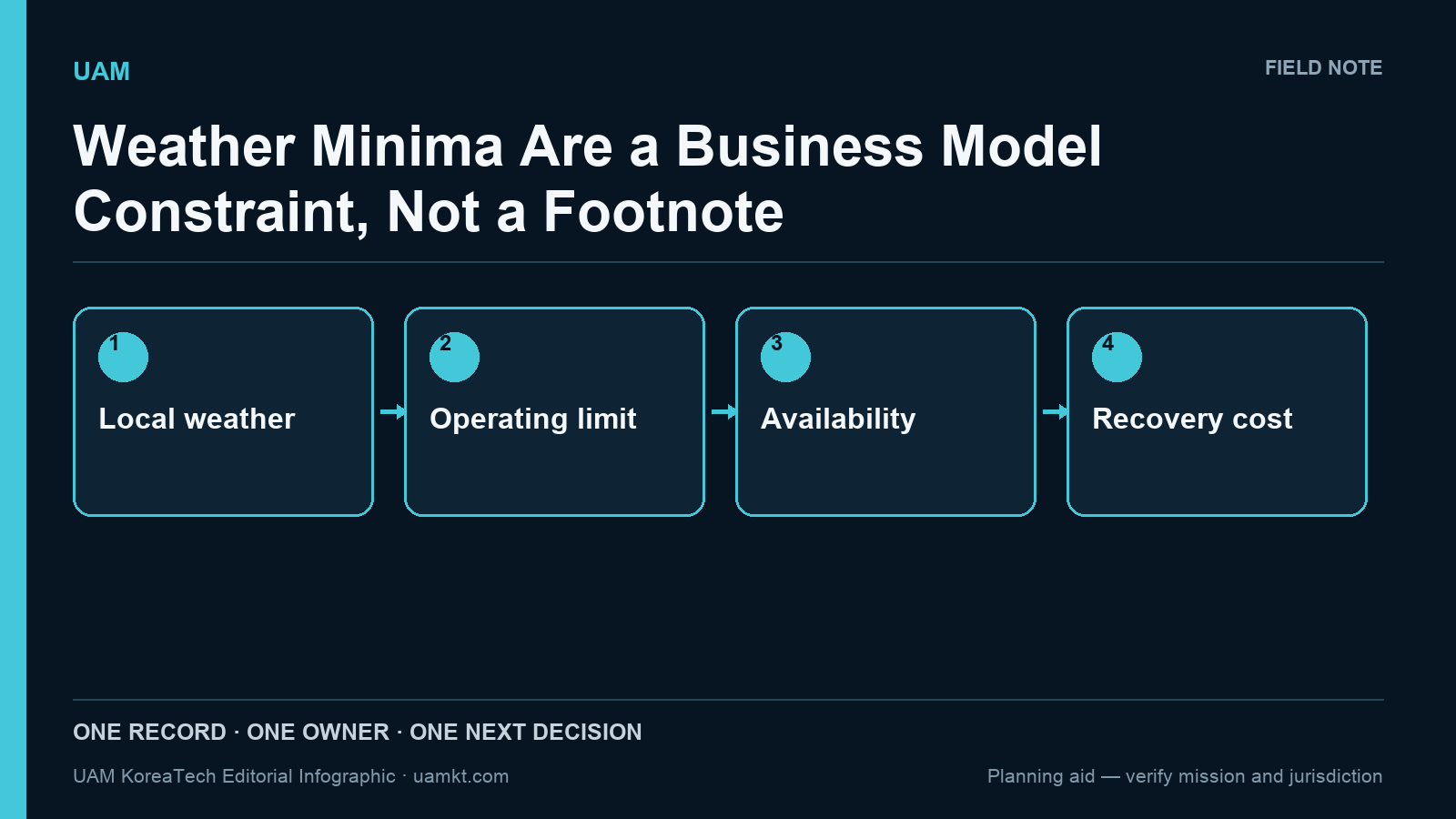
Editorial infographic: Local weather → Operating limit → Availability → Recovery cost. The diagram is a planning aid, not a certification or regulatory determination.
A four-part decision lens
- Use site-specific weather histories. Make the condition visible in the same record used for the decision.
- Apply explicit operating assumptions. Assign an owner and state what evidence will count as completion.
- Model correlated network disruption. Keep assumptions separate from observed or approved facts.
- Design passenger or cargo recovery. Test the exception path, not only the preferred operating case.
- Publish availability with exclusions. Review whether the control changed the next real decision.
What this looks like in the field
Two candidate sites have similar annual wind averages. One experiences short, predictable afternoon exceedances; the other has frequent morning crosswind conditions that affect the commuter peak. Averages make the sites look equal. A mission-hour analysis shows that they support different products.
Operational confidence comes from a traceable chain, not a confident adjective. The record should connect observation to interpretation, interpretation to authority, authority to action, and action to a verified result. Breaking any link turns review into reconstruction.
Governance before automation
Do not turn an unapproved aircraft capability into an operating promise. Separate design targets, demonstrated performance, approved limits, and planning assumptions. The commercial model should be stress-tested against tighter limits and slower recovery, not only the preferred case.
A digital form is useful only when its fields correspond to real decisions. Preserve the source observation, distinguish assumption from fact, expose overdue ownership, and keep an audit trail for changes. Do not let a green indicator erase an unresolved exception beneath it.
The practical test
Run a cold-read exercise. Give the evidence package to a colleague with no briefing and ask what happened, what was decided, what remains open, and when the issue returns for review. Record every question that requires a phone call; those questions define the next revision.
Put it to work this week
Use one live or recently completed record as a prototype. Add no new platform. Instead, clarify its source, version, owner, next trigger, and completion evidence. Reuse that structure once before turning it into a standard template.
For this topic, use “Use site-specific weather histories” as the opening prompt and “Publish availability with exclusions” as the closure check. Keep both the original and revised record so the team can see whether the intervention reduced ambiguity rather than merely changing vocabulary.
Weather resilience is not a slogan. It is the transparency with which a service converts technical limits into a credible customer promise.
For the wider workflow, see the related UAM field note and the UAM KoreaTech books and workbooks.
Source and scope note
This column adapts a decision framework from the UAM, vertiport, and low-altitude operations book series. It is educational and vendor-neutral. It does not replace site-specific safety assessment, procurement law, aviation authorization, technical instructions, or professional advice. Useful primary starting points include: