Most public conversation about Urban Air Mobility focuses on aircraft, airspace, or sensors. Practitioners know the binding constraint is elsewhere: the vertiport permit.
This note explains why permitting is the quiet bottleneck of K-UAM and what it means for software readiness.
The land-use conversion problem
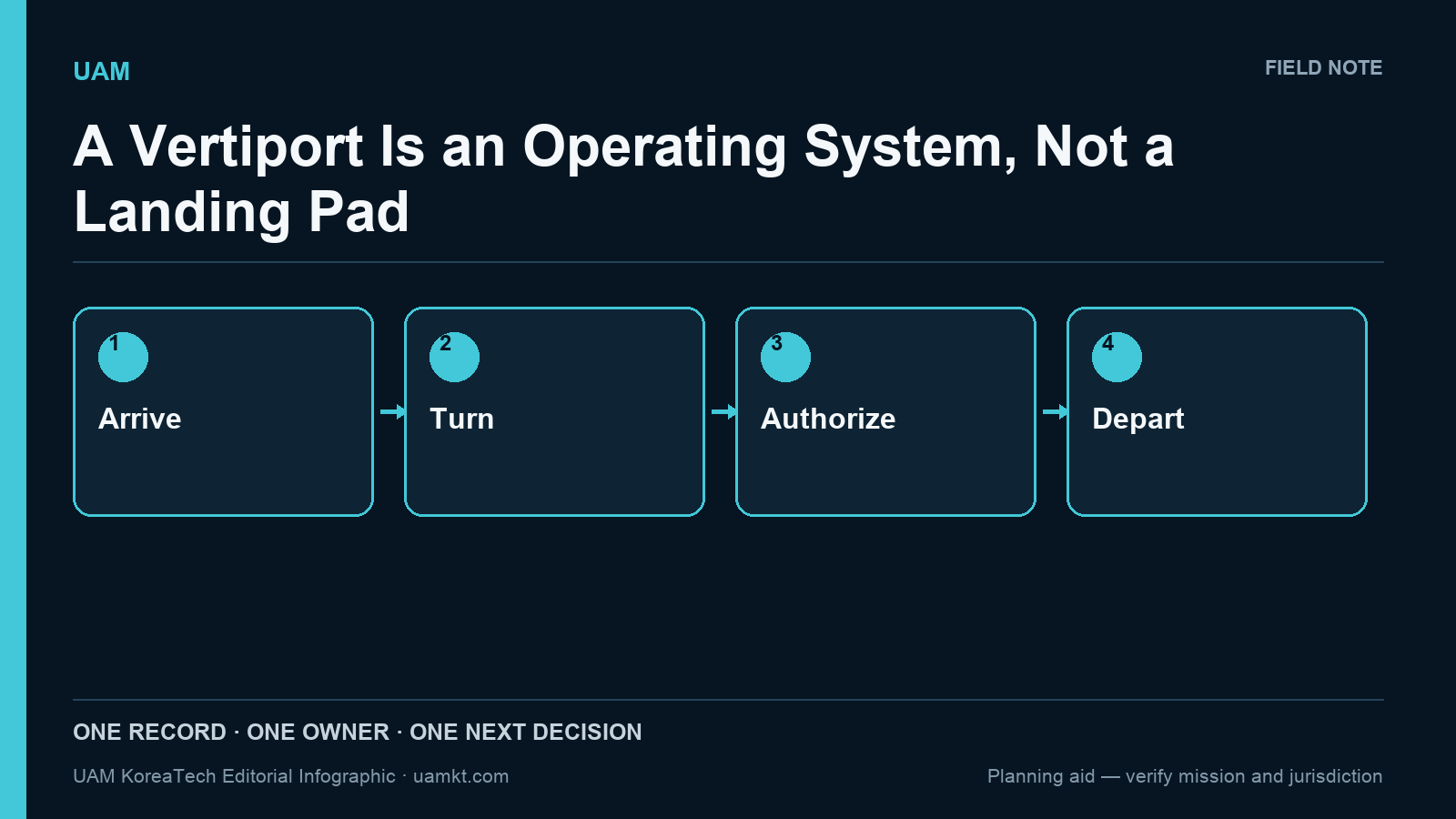
A vertiport is, in a Korean planning vocabulary, a use that does not yet exist. The municipal land-use code recognises airports, heliports, and depots. It does not recognise "vertiport." That category gap is the permitting bottleneck.
Operators run into it the moment they try to open a new pad. Use-conversion applications cite the closest existing category (usually heliport), which triggers heliport-grade obligations (proximity buffers, noise, emergency access). Some of those obligations transfer cleanly to vertiport operations; others — especially noise envelope and proximity buffers — do not match the eVTOL flight profile and have to be litigated on a per-permit basis.
What inherits from airports
Vertiports inherit airport problems whether the operator wants them to or not. Bird-strike risk exists because the airframe still intersects the same low-altitude layer. CBRN risk exists because the vertiport is a civilian access point in dense urban geography. Airspace integration with conventional rotorcraft, drones, and emergency services adds complexity without offering existing solutions.
The software question becomes: what can a vertiport operator deploy on day one? The honest answer is "not much that is vertiport-specific." Solutions like AVIX-AI BirdThreat work because they were designed for the inherited airport problem and don't require vertiport-specific infrastructure.
The K-UAM Roadmap reads optimistic
The Ministry of Land, Infrastructure and Transport's K-UAM Roadmap 2030 sketches 200+ vertiports operational by the end of the decade. Software readiness for that scale is a tractable problem. Permit readiness is not — even with optimistic assumptions, current municipal review timelines (12–24 months per permit) make that target a permit-flow constraint long before it is a software constraint.
The mismatch is structural. Software readiness compounds across deployments. Permit readiness does not — every permit is local, every permit is bespoke.
Why we publish this anyway
UAMKT does not write permit policy. We do write software that has to operate inside whatever permit envelope our partners get. Saying the constraint out loud lets us match deployment timing to actual permit windows rather than to optimistic Roadmap dates.
The K-UAM regulatory codification is currently in working-group review. We are open to contributing to the codification effort — see Engagement on the Solutions overview for the procedural options.
—
Inquiries: ceo@uamkt.com
Primary reference: 국토교통부 (2024). K-UAM Roadmap 2030. Korean Ministry of Land, Infrastructure and Transport.