Concrete and paint can define a pad; they cannot deliver a dependable passenger or cargo movement.
The visual icon of advanced air mobility is a vehicle touching down on a rooftop. The operational reality is less cinematic: arrival sequencing, passenger or cargo handoff, energy replenishment, weather monitoring, access control, turnaround inspection, data exchange, and irregular-operation recovery. The landing surface is one component in a larger service system.
Treating the vertiport as an operating system changes design questions. Instead of asking only how many stands fit, planners ask which decisions must be synchronized, which resource becomes the bottleneck, what evidence authorizes the next movement, and how the site returns to a safe state after disruption.
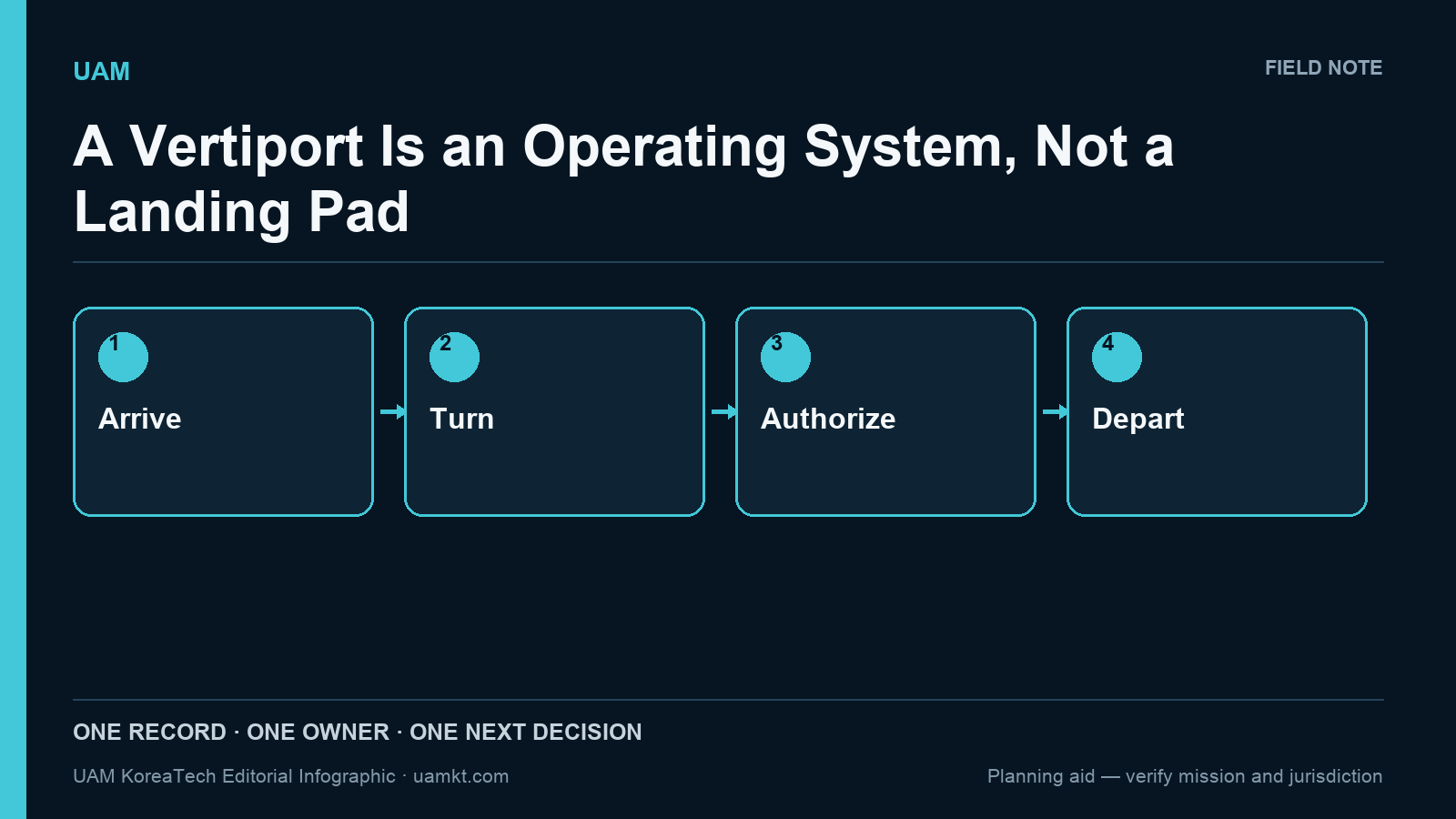
Editorial infographic: Arrive → Turn → Authorize → Depart. The diagram is a planning aid, not a certification or regulatory determination.
A four-part decision lens
- Map every arrival-to-departure handoff. Make the condition visible in the same record used for the decision.
- Name decision owners and interfaces. Assign an owner and state what evidence will count as completion.
- Model energy and stand constraints. Keep assumptions separate from observed or approved facts.
- Define irregular-operation states. Test the exception path, not only the preferred operating case.
- Retain a reviewable movement record. Review whether the control changed the next real decision.
What this looks like in the field
An aircraft arrives on time, but the next departure is delayed because the passenger group is not cleared, the charging asset is occupied, and a weather limit is approaching. None of those failures belongs to the pad itself. Together they determine capacity, customer confidence, and safety margin.
A useful record shows movement, not just status. “Reviewed” and “acceptable” describe a moment; they do not explain what changed, who accepted the remaining uncertainty, or what condition would trigger another decision. The handoff becomes durable only when evidence, authority, and the reopening rule travel together.
Governance before automation
A concept of operations should connect infrastructure assumptions to actual roles, data, and fallback procedures. Site capacity should be stated with its operating assumptions—turnaround time, charging policy, staffing, weather availability, and recovery buffer—rather than as a stand count alone.
Technology should remove clerical friction after the control has been designed. Start with the decision owner, required fields, exception route, and retained artifact. Only then decide which reminders, calculations, or visual summaries can be automated without obscuring accountability.
The practical test
Hand the record to someone outside the original meeting. If that reader cannot explain the condition, owner, evidence, decision, and next trigger within five minutes, the workflow still depends on oral history. Repair that gap before buying another dashboard.
Put it to work this week
Take one recent case that produced delay or disagreement. Reconstruct the decision from the files that actually existed at the time, mark the first missing fact or authority, and add one control for the next comparable case. Compare reconstruction time before and after the change.
For this topic, use “Map every arrival-to-departure handoff” as the opening prompt and “Retain a reviewable movement record” as the closure check. Keep both the original and revised record so the team can see whether the intervention reduced ambiguity rather than merely changing vocabulary.
The useful unit of vertiport design is not the landing event. It is the controlled journey from one released movement to the next.
For the wider workflow, see the related UAM field note and the UAM KoreaTech books and workbooks.
Source and scope note
This column adapts a decision framework from the UAM, vertiport, and low-altitude operations book series. It is educational and vendor-neutral. It does not replace site-specific safety assessment, procurement law, aviation authorization, technical instructions, or professional advice. Useful primary starting points include: