Public acceptance is not a permanent approval rating. It is a conditional response to a proposed service, its risks, and the way the question is asked.
Urban air mobility discussions often compress public acceptance into a single percentage. That is attractive for a presentation, but weak for a decision. Laura Babetto’s 2025 doctoral dissertation at RWTH Aachen University offers a more useful evidence point: a multilingual survey of 421 complete responses across nine mid-sized European cities, embedded in a broader study of UAM conceptual design and safety assessment. The reported results indicate a 62% inclination toward UAM adoption and a 74% preference for aviation-grade safety, expressed in the study as a target failure rate of 10⁻⁹ failures per flight hour.
These figures matter because they place safety inside the acceptance question. They do not establish a Korean adoption rate, prove willingness to pay, or show that any vehicle has achieved the stated safety target. The practical value is narrower and stronger: early UAM market research should measure the conditions attached to interest, rather than treating interest as unconditional demand.
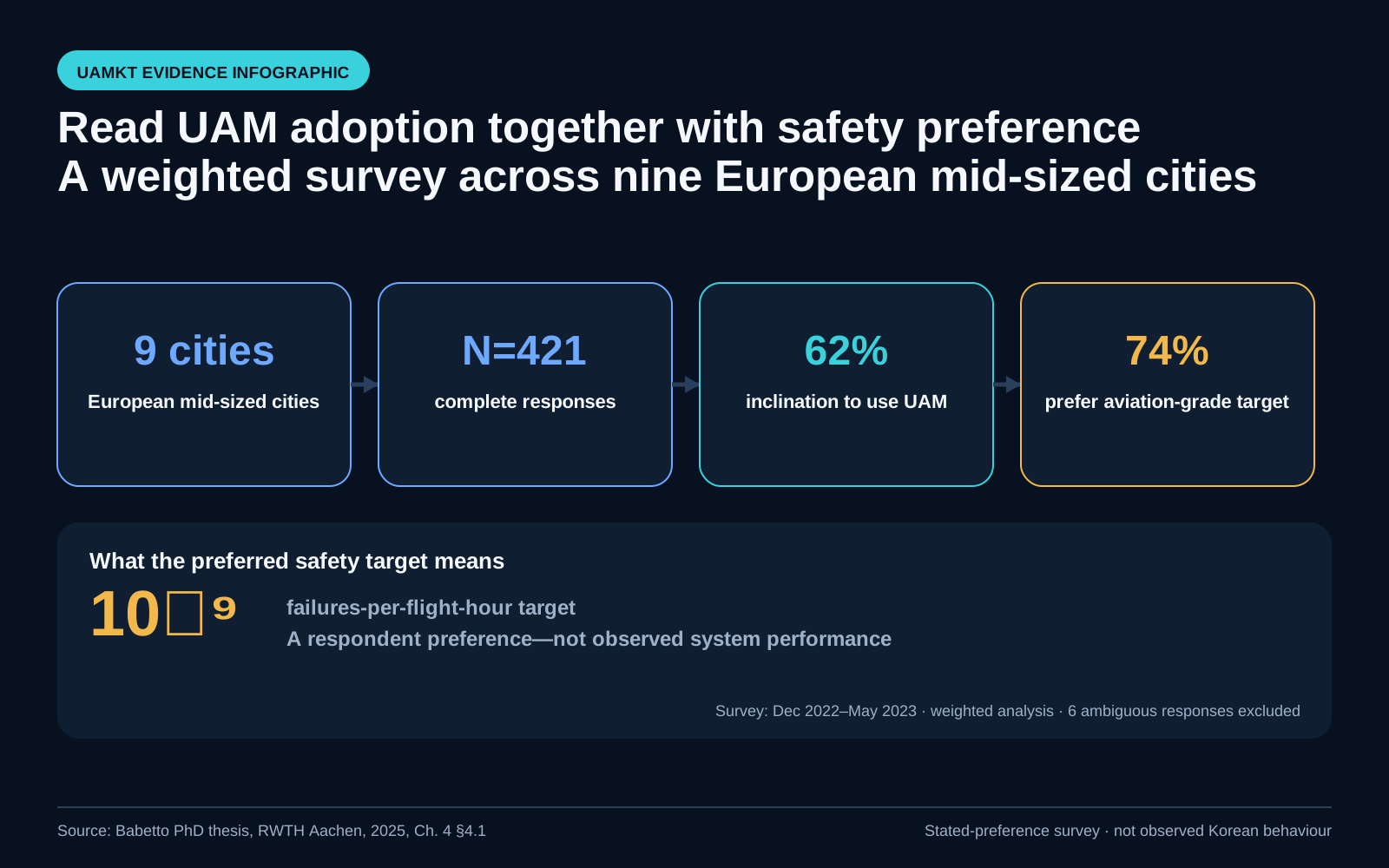
Editorial evidence graphic. The percentages describe a weighted stated-preference survey in nine European cities; they are not observed Korean behavior or certified vehicle performance.
How the survey was designed
The public-acceptance study selected Aachen, Cádiz Bay, Eindhoven, Liège, Lille, Milton Keynes, Odense, Padua, and Porto. The cities were chosen using demographic and socioeconomic considerations, nearby-airfield context, technical-university presence, and a broadly comparable addressable market. Survey distribution ran from December 2022 through May 2023 and used multiple languages. English was used in the United Kingdom, Denmark, and the Netherlands based on the study’s language-proficiency rationale.
The final dataset contained 421 complete questionnaires after six responses were removed because of ambiguity in open-ended answers. The sample exceeded the study’s target of 370. Gender was approximately balanced: 49% male, 50% female, and less than 1% other. The age distribution was 30% aged 20–29, 25% aged 30–39, 24% aged 40–49, 12% aged 50–59, and 9% aged 60–70. Most country groups represented roughly 12–13% of responses, while Portugal represented 3%.
The sample was not evenly distributed on every dimension. Education, age, and residential distance from the city center were uneven, so the study applied weights before its statistical analysis. That is an essential part of the evidence, not a footnote to remove. A weighted result estimates the study’s intended composition; it is not the same as a simple count of respondents, and it does not repair every source of selection or cultural bias.
The numbers and their proper units
| Evidence point | Reported value | Unit and condition | What it supports |
|---|---|---|---|
| Complete questionnaires | 421 | Respondents across nine selected European cities | The analyzed survey base |
| Responses removed | 6 | Ambiguous open-ended responses | A documented cleaning step |
| Inclination toward UAM adoption | 62% | Weighted stated preference in the study context | Moderate interest under the presented conditions |
| Preference for aviation-grade safety | 74% | Share of respondents; target framed as 10⁻⁹ failures per flight hour | Safety as a prominent acceptance condition |
| UAM concepts used elsewhere in the dissertation | 280 | Concept database, not survey respondents | Breadth of the separate conceptual-design method |
The distinction between the last two columns is critical. A preference for 10⁻⁹ failures per flight hour does not mean that respondents independently calculated an acceptable risk threshold. It records their response to a safety standard as framed by the research. Likewise, the 62% result is an inclination, not a ticket purchase, a referendum result, or continued acceptance after exposure to actual routes, noise, fares, incidents, or visual impacts.
The dissertation also reports a modeled reduction in estimated system failure probability in a separate heavy-lift drone case study. That safety-model output must not be presented as observed operational performance, and it must not be used to imply that the survey respondents evaluated that specific design. The acceptance survey, design database, and safety assessment are connected within the dissertation’s framework, but they remain different evidence streams.
Claim boundaries for public communication
It is supportable to say that this survey found moderate UAM adoption inclination and that safety emerged as a primary concern. It is also supportable to state the sample, cities, collection period, weighting, and reported safety preference. It is not supportable to say that “Europe accepts UAM,” that 62% of Koreans will use an air taxi, or that a 74% safety preference validates a particular aircraft.
Transfer to Korea requires a new sampling frame, Korean-language cognitive testing, locally plausible route and fare scenarios, and treatment of neighborhood effects. A respondent may support UAM in principle while opposing a vertiport near home. Acceptance may also change when questions introduce noise frequency, privacy, emergency routing, ground risk, equity, or the opportunity cost of public investment. Those are not reasons to discard the European result. They are reasons to use it as a hypothesis generator rather than a market forecast.
What a Korean UAM team should do next
First, separate general awareness from a choice task. Ask whether respondents understand the service, then present specific journeys with time, price, access, noise, and safety information. Second, record both user and non-user exposure. Residents under a route may carry impacts without purchasing the service. Third, test how the safety description changes answers. A numerical failure rate, a comparison with commercial aviation, and a plain-language consequence statement may not produce equivalent responses.
Fourth, preserve subgroup and location information before publishing one headline percentage. Distance to a proposed site, age, prior drone exposure, travel purpose, and trust in the operator can reveal decision-relevant differences. Finally, pre-register which result would change the program. A survey that cannot stop, relocate, or redesign a pilot is communications research, not decision research.
Evidence-use checklist
- State that the 421 responses came from nine selected European cities.
- Label 62% and 74% as reported stated-preference findings.
- Keep 10⁻⁹ in failures per flight hour and describe it as a preferred target.
- Disclose that demographic and residential variables required weighting.
- Do not translate European survey percentages into Korean demand.
- Do not equate inclination with willingness to pay or actual use.
- Keep modeled safety, certified performance, and observed operations separate.
- Pair any Korean claim with a Korean sampling and scenario design.
- Publish the question wording and response options when using results externally.
- Define the operational decision that each survey item is meant to inform.
Official source and Scholar title search
- Laura Babetto (2025), Public acceptance and safety assessment of urban air mobility in conceptual design, doctoral dissertation, RWTH Aachen University: official repository record, full text, and DOI.
- Reproducible discovery query: Google Scholar exact-title search. Scholar availability and ranking can vary by user, region, and indexing date; the university record is the controlling bibliographic source used here.
This field note paraphrases the dissertation and does not reproduce its prose. Recheck the official record and full text before using the findings in a regulatory filing, investment model, or public-opinion claim.