A new mobility service is credible when its operating claims can be traced to controlled evidence.
Advanced air mobility combines aircraft, software, infrastructure, crews, energy, and local operations. Each domain can produce its own documents while the overall service remains hard to review. An evidence room solves that fragmentation by organizing records around decisions: what is authorized, what configuration is active, who is current, and what changed.
The room need not be a physical space or an expensive platform. It is a controlled index that connects operating authority, manuals, aircraft and software baselines, training and currency, maintenance status, site interfaces, weather decision rules, incident records, and corrective actions. Access and retention rules matter as much as folder names.
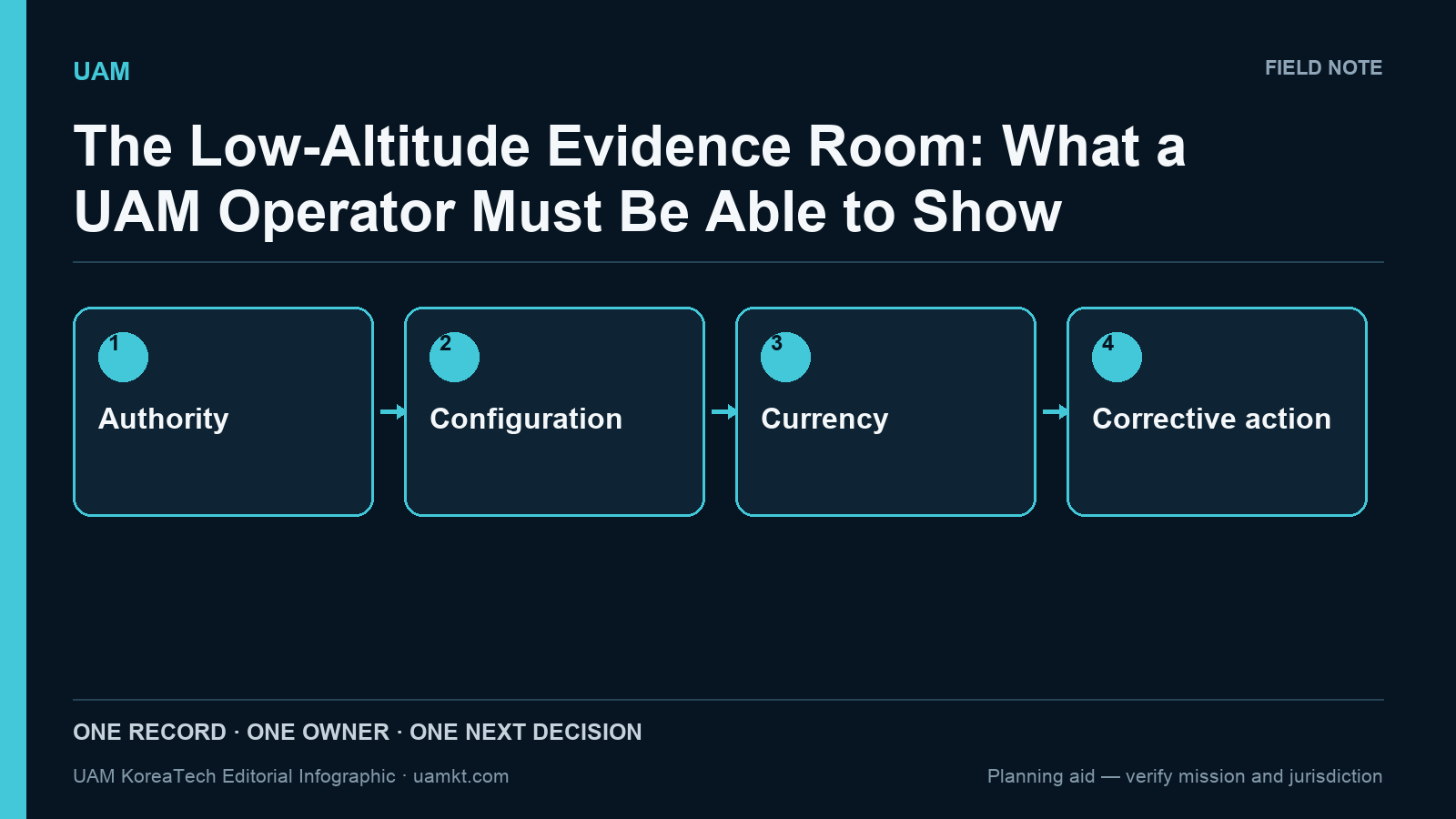
Editorial infographic: Authority → Configuration → Currency → Corrective action. The diagram is a planning aid, not a certification or regulatory determination.
A four-part decision lens
- Index authority and applicability. Make the condition visible in the same record used for the decision.
- Identify active configuration. Assign an owner and state what evidence will count as completion.
- Connect people and asset currency. Keep assumptions separate from observed or approved facts.
- Link incidents to corrective action. Test the exception path, not only the preferred operating case.
- Control change and superseded records. Review whether the control changed the next real decision.
What this looks like in the field
After a software update, an operator can show the approved version, affected aircraft, validation record, crew briefing, updated procedure, and first missions under monitoring. Without that chain, the update may be technically successful but organizationally invisible.
The final quality check is reversibility of understanding: another person should be able to walk backward from the outcome to the evidence and forward from the trigger to the required action. When either direction fails, the control is too dependent on memory or personality.
Governance before automation
The evidence room should avoid collecting personal or commercially sensitive data without purpose. Define ownership, access, retention, correction, and disposal. A record proves only what it contains; it does not replace regulatory approval or independent assurance.
Use automation to protect sequence and completeness, not to manufacture certainty. Version the inputs, flag missing fields, show exceptions, and retain who changed what. Keep the basis of the decision visible beside the summary so that speed does not come at the cost of reviewability.
The practical test
Ask two independent readers to classify the same record and name the next required action. If their answers diverge, locate whether the problem is an ambiguous threshold, missing evidence, unclear authority, or an undefined exception path. Fix that variable and repeat the exercise.
Put it to work this week
Pick one decision that will recur this month. Define the smallest complete evidence packet, the responsible role, the response time, and the reopening condition. Observe the next occurrence and revise only from what the trial reveals.
For this topic, use “Index authority and applicability” as the opening prompt and “Control change and superseded records” as the closure check. Keep both the original and revised record so the team can see whether the intervention reduced ambiguity rather than merely changing vocabulary.
The strongest low-altitude service is not the one with the largest document library. It is the one that can answer a reasonable reviewer’s next question without assembling the story from memory.
For the wider workflow, see the related UAM field note and the UAM KoreaTech books and workbooks.
Source and scope note
This column adapts a decision framework from the UAM, vertiport, and low-altitude operations book series. It is educational and vendor-neutral. It does not replace site-specific safety assessment, procurement law, aviation authorization, technical instructions, or professional advice. Useful primary starting points include: