A patrol becomes intelligence only when observations can be compared across time, place, and operating condition.
The phrase “birds observed near runway” may be accurate and still be nearly useless. It does not say which end, what altitude, which direction, whether aircraft were moving, what the weather was, or whether the same behavior happened yesterday. Free-text patrol notes preserve memory but rarely create a reliable operational pattern.
A time-stamped hazard log should be small enough to complete in the field and structured enough to compare. The minimum record links observer, time, location, species or size band, count band, behavior, direction, aircraft activity, weather context, response, and confidence. Photographs and sensor detections can support the record, but they should not replace its essential fields.
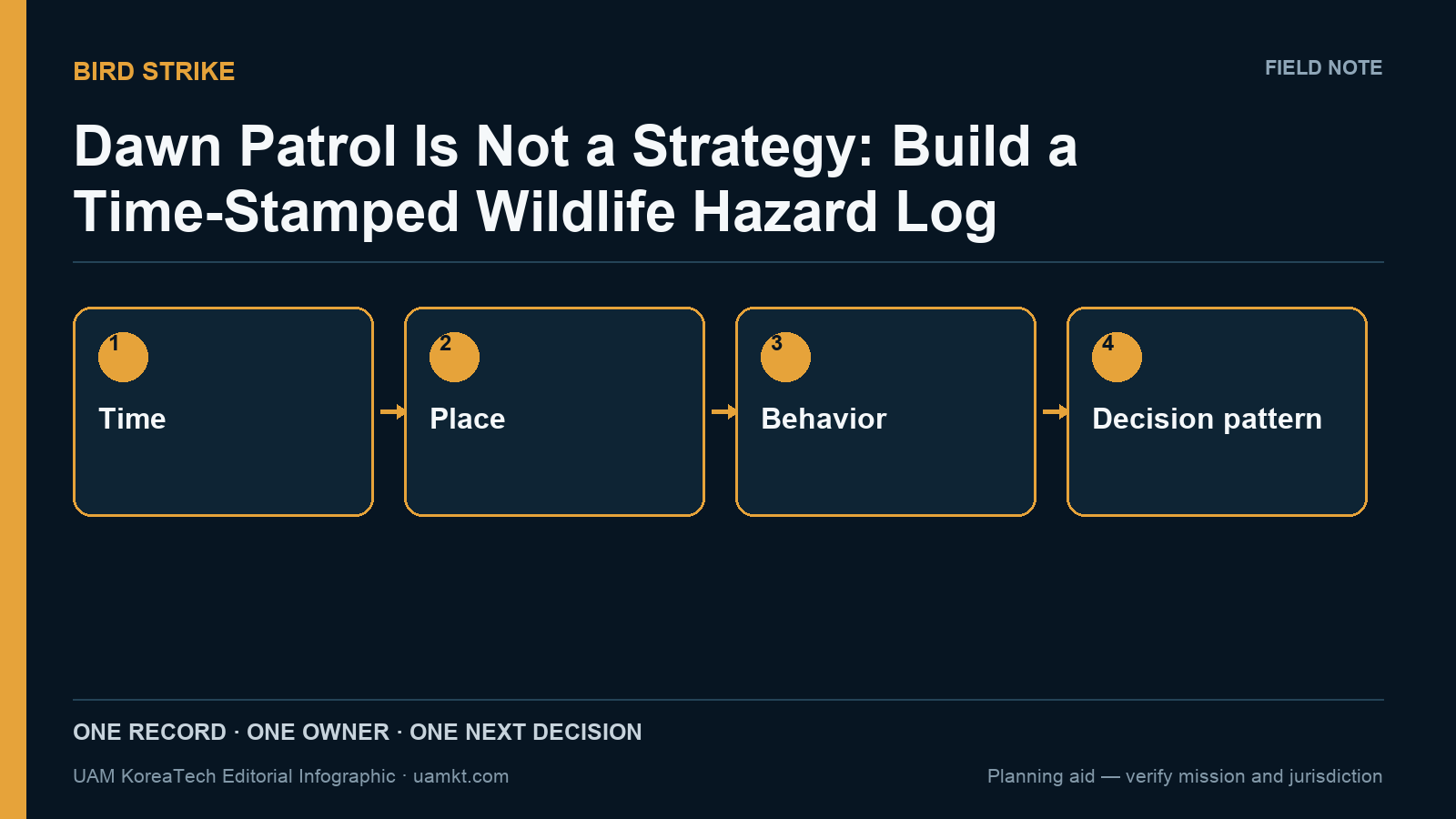
Editorial infographic: Time → Place → Behavior → Decision pattern. The diagram is a planning aid, not a certification or regulatory determination.
A four-part decision lens
- Use a shared location grid. Make the condition visible in the same record used for the decision.
- Record behavior and direction. Assign an owner and state what evidence will count as completion.
- Link aircraft activity and weather. Keep assumptions separate from observed or approved facts.
- Mark response and confidence. Test the exception path, not only the preferred operating case.
- Review repeated windows weekly. Review whether the control changed the next real decision.
What this looks like in the field
After six weeks, the log reveals that a recurring crossing occurs not simply “at dawn” but during a narrow period after irrigation, with light wind from one sector and departures using a particular runway. That pattern supports a specific inspection and scheduling discussion. The same insight would remain buried in a folder of narrative patrol reports.
Operational confidence comes from a traceable chain, not a confident adjective. The record should connect observation to interpretation, interpretation to authority, authority to action, and action to a verified result. Breaking any link turns review into reconstruction.
Governance before automation
Do not force false precision. If a species cannot be identified, use an agreed size or group code. If visibility is poor, record low confidence. Missingness is operational information: a blank hour during peak movement should not be treated as evidence of no wildlife. The log must distinguish “not observed” from “not checked.”
A digital form is useful only when its fields correspond to real decisions. Preserve the source observation, distinguish assumption from fact, expose overdue ownership, and keep an audit trail for changes. Do not let a green indicator erase an unresolved exception beneath it.
The practical test
Run a cold-read exercise. Give the evidence package to a colleague with no briefing and ask what happened, what was decided, what remains open, and when the issue returns for review. Record every question that requires a phone call; those questions define the next revision.
Put it to work this week
Use one live or recently completed record as a prototype. Add no new platform. Instead, clarify its source, version, owner, next trigger, and completion evidence. Reuse that structure once before turning it into a standard template.
For this topic, use “Use a shared location grid” as the opening prompt and “Review repeated windows weekly” as the closure check. Keep both the original and revised record so the team can see whether the intervention reduced ambiguity rather than merely changing vocabulary.
The goal is not a larger database. It is a record that lets the next shift see what the previous shift could not yet know.
For the wider workflow, see the related Bird Strike field note and the UAM KoreaTech books and workbooks.
Source and scope note
This column adapts a decision framework from the BirdStrike final manuscript and the AVIX-AI field-note archive. It is educational and vendor-neutral. It does not replace site-specific safety assessment, procurement law, aviation authorization, technical instructions, or professional advice. Useful primary starting points include: