The score is not the decision. It is the signal that a decision is due.
Airfields often invest considerable effort in producing a red, amber, or green risk picture. The color is then emailed, discussed, and archived. What is missing is the conversion rule: what precisely must happen when a score crosses a threshold, who owns it, and what evidence permits the case to close. Without that rule, the dashboard documents concern instead of controlling it.
An intervention ladder should be written before the next alert. Low-level signals may require observation and trend confirmation. Repeated movement-path exposure may require habitat inspection, operating coordination, or a targeted deterrence plan. An acute condition may require an immediate operational restriction under the airport's approved procedures. The trigger, authority, and maximum response time must be explicit.
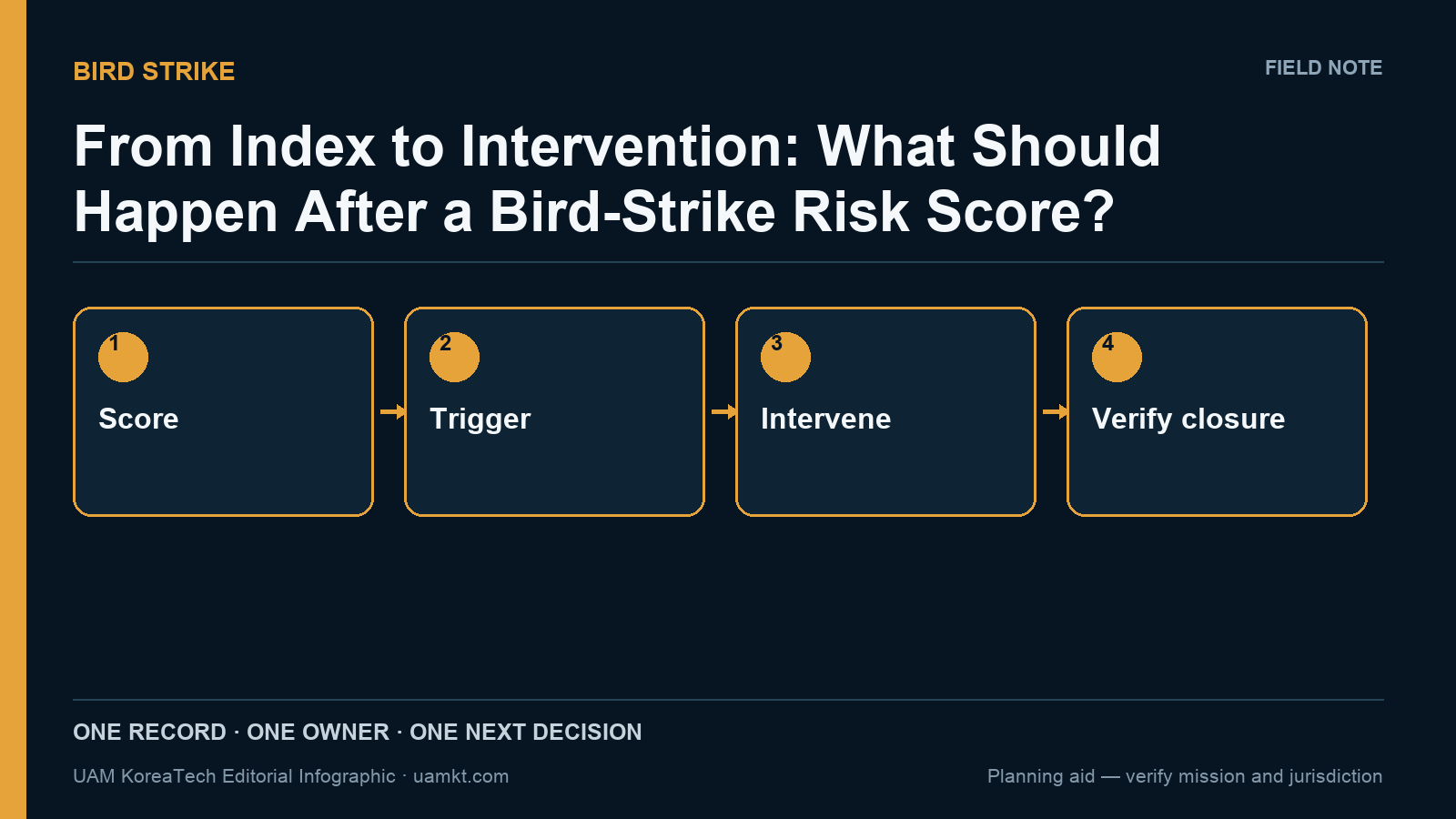
Editorial infographic: Score → Trigger → Intervene → Verify closure. The diagram is a planning aid, not a certification or regulatory determination.
A four-part decision lens
- Define threshold-to-action rules. Make the condition visible in the same record used for the decision.
- Name the decision owner. Assign an owner and state what evidence will count as completion.
- Set a response clock. Keep assumptions separate from observed or approved facts.
- Capture before-and-after evidence. Test the exception path, not only the preferred operating case.
- Close, extend, or escalate with reasons. Review whether the control changed the next real decision.
What this looks like in the field
A drainage area near a taxiway moves into the high-priority band after three dawn observations. The useful response is not “monitor closely.” It is a work order with a responsible unit, a site inspection deadline, an interim operating note, photographs, follow-up observations, and a closure decision. The score starts the chain; the record proves whether the chain worked.
The management value lies in the boundary between one state and the next. A team must be able to see why an item moved from observation to action, from action to restriction, or from restriction to closure. If the transition has no named authority and no retained basis, the label is only decoration.
Governance before automation
Thresholds need sensitivity review. If the high band fires every day, it becomes background noise. If it never fires, the model may be protecting its own appearance. Review false alarms, missed events, seasonal shifts, and overrides. Every override should record who decided, what information was used, and when the issue will be reconsidered.
Begin automation with an exception map rather than a feature list. Identify what may proceed normally, what requires review, what must stop, and which person can release it. Software can then surface deadlines and missing evidence without pretending to make the consequential judgment.
The practical test
Select a closed case and remove the people who remember it from the review. Ask a new reader to reproduce the sequence and identify the closure evidence. Any answer that begins with “I think” identifies a field, timestamp, or approval trail that the process failed to preserve.
Put it to work this week
Choose the most recent exception in this topic. Write its starting condition, decision clock, owner, evidence requirement, and closure rule on one page. Test the page with a second person and change the one line that creates the longest argument.
For this topic, use “Define threshold-to-action rules” as the opening prompt and “Close, extend, or escalate with reasons” as the closure check. Keep both the original and revised record so the team can see whether the intervention reduced ambiguity rather than merely changing vocabulary.
A risk system earns trust when a reader can move from color to consequence, from consequence to action, and from action to verified closure without guessing.
For the wider workflow, see the related Bird Strike field note and the UAM KoreaTech books and workbooks.
Source and scope note
This column adapts a decision framework from the BirdStrike final manuscript and the AVIX-AI field-note archive. It is educational and vendor-neutral. It does not replace site-specific safety assessment, procurement law, aviation authorization, technical instructions, or professional advice. Useful primary starting points include: