A busy airfield can record fewer birds than a quiet one and still carry the larger strike exposure.
Bird counts are visible, easy to compare, and dangerously seductive. A large number looks serious; a small number feels reassuring. Yet an airport does not manage birds in the abstract. It manages encounters between wildlife, aircraft movements, operating surfaces, time windows, and consequences. A count becomes useful only when it is connected to that encounter geometry.
The practical unit of analysis is not “birds observed.” It is a time-stamped exposure: which species or flock was present, where it intersected a movement path, when aircraft were operating, how severe a contact could be, and how confident the observation was. This prevents a dramatic but remote flock from outranking a smaller recurring hazard at a runway threshold.
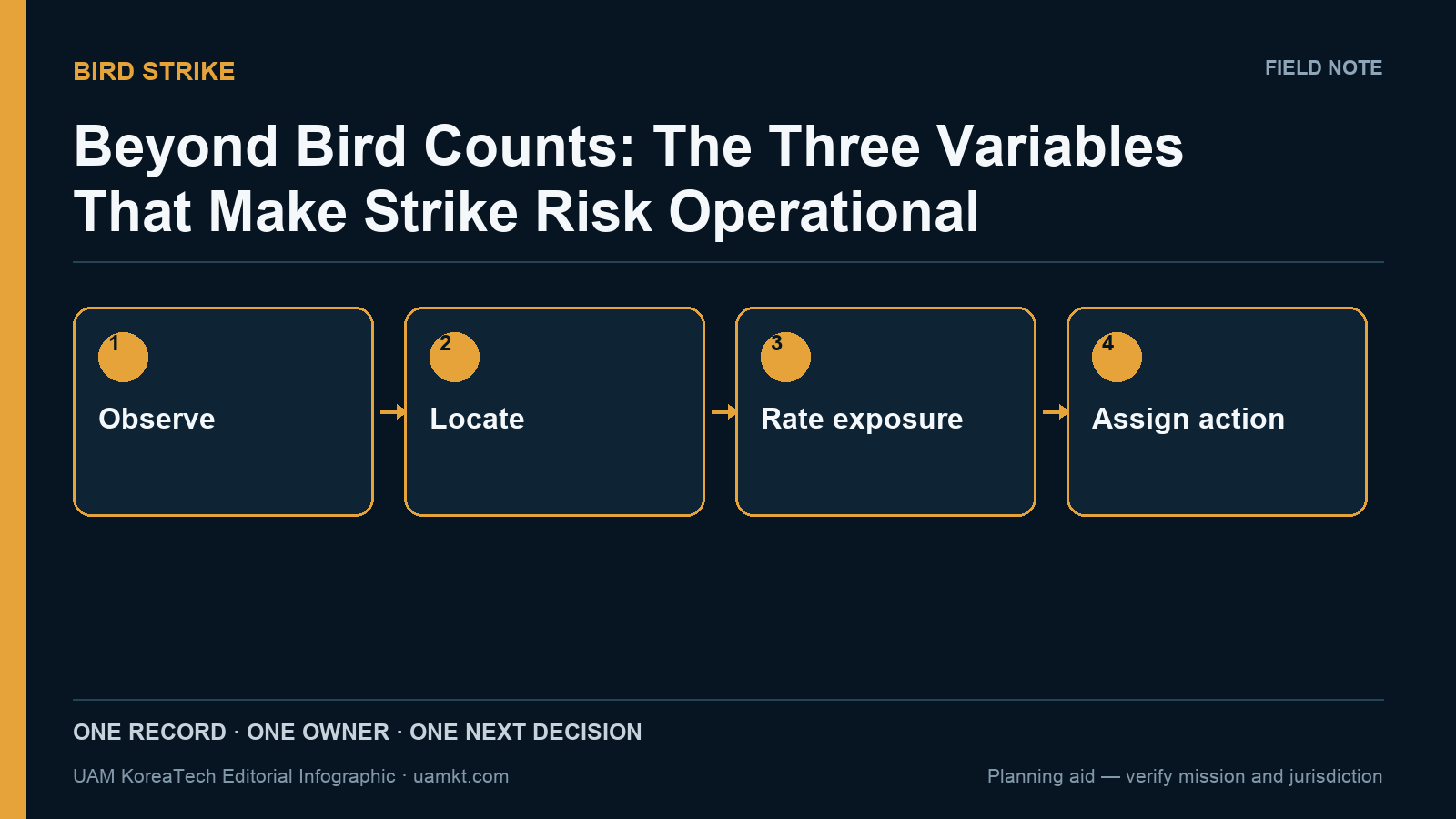
Editorial infographic: Observe → Locate → Rate exposure → Assign action. The diagram is a planning aid, not a certification or regulatory determination.
A four-part decision lens
- Record location and time, not count alone. Make the condition visible in the same record used for the decision.
- Separate encounter likelihood from consequence. Assign an owner and state what evidence will count as completion.
- Weight recurrent movement-path intersections. Keep assumptions separate from observed or approved facts.
- Show confidence and missing observations. Test the exception path, not only the preferred operating case.
- Tie every elevated score to an owner and action. Review whether the control changed the next real decision.
What this looks like in the field
Imagine two morning reports. Site A records 180 birds on a wetland outside the protected operating area. Site B records twelve medium-sized birds repeatedly crossing an active departure path during the first wave of flights. A count-only dashboard highlights Site A. An exposure-led dashboard escalates Site B, while still tracking the wetland trend. The second view is less dramatic and more operationally honest.
A useful record shows movement, not just status. “Reviewed” and “acceptable” describe a moment; they do not explain what changed, who accepted the remaining uncertainty, or what condition would trigger another decision. The handoff becomes durable only when evidence, authority, and the reopening rule travel together.
Governance before automation
A composite index should never hide its ingredients. Display the raw observation, exposure assumption, consequence band, confidence level, and resulting priority together. If a manager cannot reconstruct why a location moved from watch to intervention, the index has become a black box rather than a control.
Technology should remove clerical friction after the control has been designed. Start with the decision owner, required fields, exception route, and retained artifact. Only then decide which reminders, calculations, or visual summaries can be automated without obscuring accountability.
The practical test
Hand the record to someone outside the original meeting. If that reader cannot explain the condition, owner, evidence, decision, and next trigger within five minutes, the workflow still depends on oral history. Repair that gap before buying another dashboard.
Put it to work this week
Take one recent case that produced delay or disagreement. Reconstruct the decision from the files that actually existed at the time, mark the first missing fact or authority, and add one control for the next comparable case. Compare reconstruction time before and after the change.
For this topic, use “Record location and time, not count alone” as the opening prompt and “Tie every elevated score to an owner and action” as the closure check. Keep both the original and revised record so the team can see whether the intervention reduced ambiguity rather than merely changing vocabulary.
The best bird-strike metric is not the one with the most decimals. It is the one that makes a defensible intervention visible before the next aircraft movement.
For the wider workflow, see the related Bird Strike field note and the UAM KoreaTech books and workbooks.
Source and scope note
This column adapts a decision framework from the BirdStrike final manuscript and the AVIX-AI field-note archive. It is educational and vendor-neutral. It does not replace site-specific safety assessment, procurement law, aviation authorization, technical instructions, or professional advice. Useful primary starting points include: