Wildlife presence is often the visible output of an invisible resource system.
When birds gather near an operating surface, the first instinct is often to ask how to disperse them. The more durable question is why that place is rewarding enough for them to return. Food, water, shelter, resting surfaces, thermal conditions, and predictable disturbance patterns can turn ordinary infrastructure into persistent habitat.
A habitat reading begins with function rather than appearance. Long grass may shelter prey; very short grass may expose food. Standing water may be obvious, while a blocked drain or temporary construction depression is not. Waste handling, lighting structures, roof edges, nearby agriculture, and tidal or seasonal conditions can shape movement across the airfield boundary.
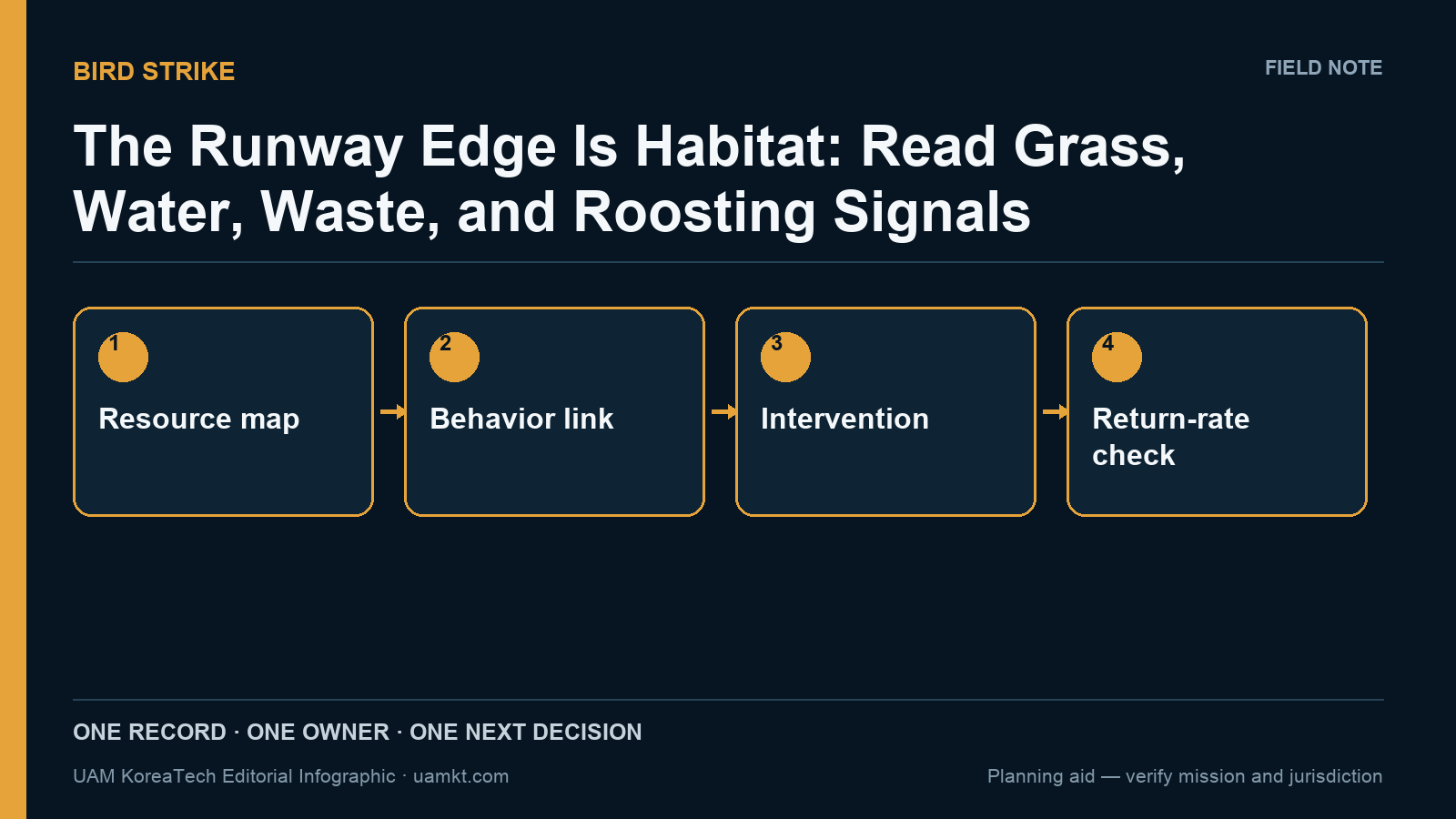
Editorial infographic: Resource map → Behavior link → Intervention → Return-rate check. The diagram is a planning aid, not a certification or regulatory determination.
A four-part decision lens
- Map resources, not only sightings. Make the condition visible in the same record used for the decision.
- Connect behavior to the resource. Assign an owner and state what evidence will count as completion.
- Check boundary and off-site drivers. Keep assumptions separate from observed or approved facts.
- Choose a reversible first intervention. Test the exception path, not only the preferred operating case.
- Measure return rate after the change. Review whether the control changed the next real decision.
What this looks like in the field
A repeated flock near the same pavement is initially treated with patrol dispersal. A structured habitat walk shows that the birds arrive after maintenance activity exposes insects along a narrow verge. Adjusting the maintenance sequence and monitoring the verge may address the return mechanism more effectively than simply increasing patrol frequency.
A workflow becomes controllable when the team can explain both progression and refusal. It should be clear why work advanced, why it paused, and what evidence would permit a different outcome. This is especially important when schedules create pressure to convert an unresolved condition into an informal acceptance.
Governance before automation
Habitat action should be coordinated with environmental, engineering, and operational responsibilities. A change that reduces one attractant can create another, affect drainage, or conflict with protected-species obligations. Record the hypothesis, intervention, expected response, observation period, and reversal condition before work begins.
Automate visibility before authority. Reminders, completeness checks, version comparison, and overdue queues can help; release and closure still need an attributable role and an intelligible basis. A fast workflow that hides judgment is harder to govern than a slow transparent one.
The practical test
Review one case that was delayed or overridden. Can the record identify the original trigger, the person with authority, the evidence available at that moment, and the later verification? If not, the organization has stored documents without storing the decision.
Put it to work this week
Find a recurring handoff where two teams interpret readiness differently. Agree on one observable entry condition and one completion artifact, then test them on the next handoff. Keep the disagreement log; it is evidence for improving the rule.
For this topic, use “Map resources, not only sightings” as the opening prompt and “Measure return rate after the change” as the closure check. Keep both the original and revised record so the team can see whether the intervention reduced ambiguity rather than merely changing vocabulary.
The airfield edge is not empty space. It is a managed ecological interface, and good mitigation starts by reading what that interface is offering.
For the wider workflow, see the related Bird Strike field note and the UAM KoreaTech books and workbooks.
Source and scope note
This column adapts a decision framework from the BirdStrike final manuscript and the AVIX-AI field-note archive. It is educational and vendor-neutral. It does not replace site-specific safety assessment, procurement law, aviation authorization, technical instructions, or professional advice. Useful primary starting points include: