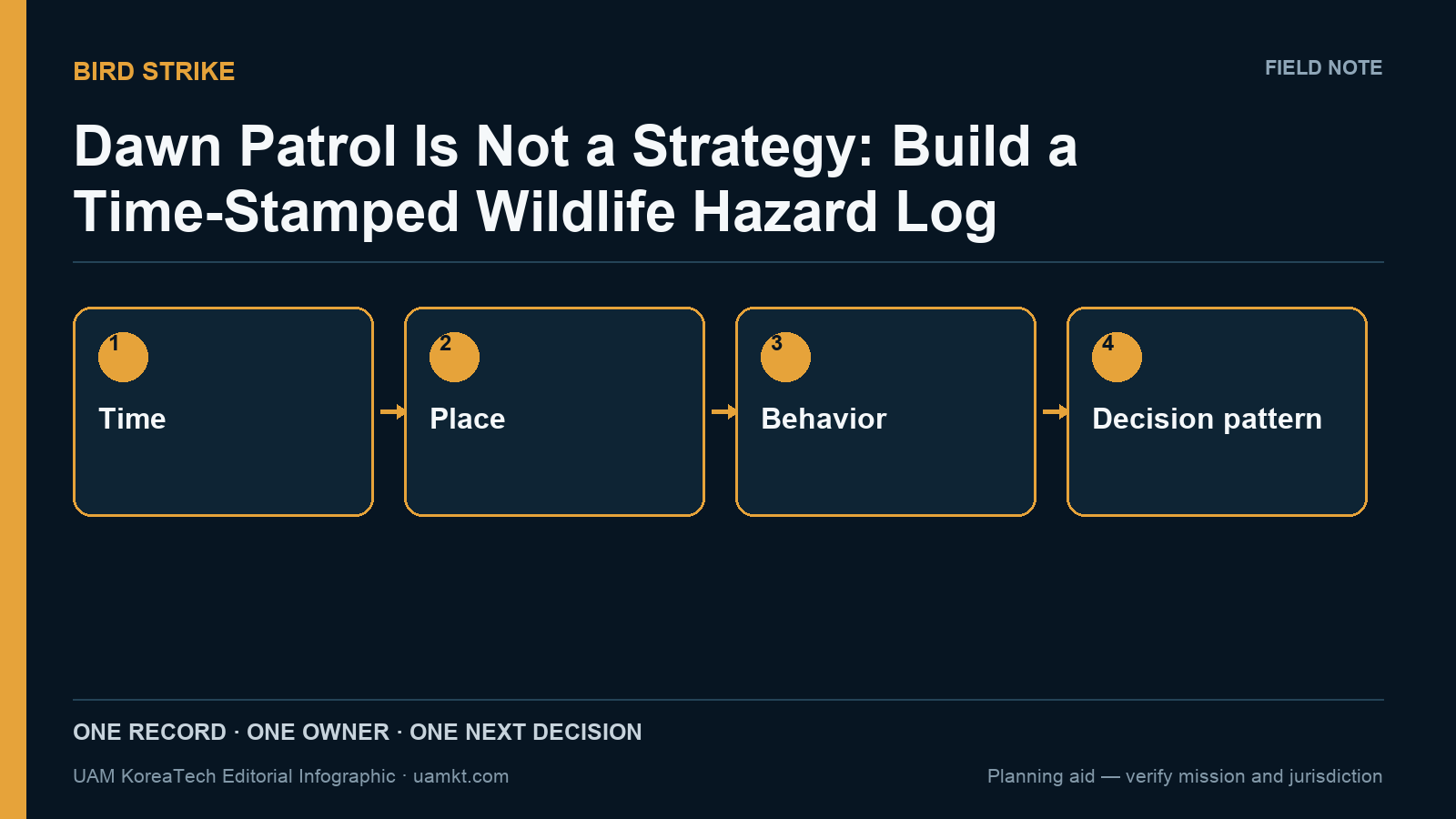
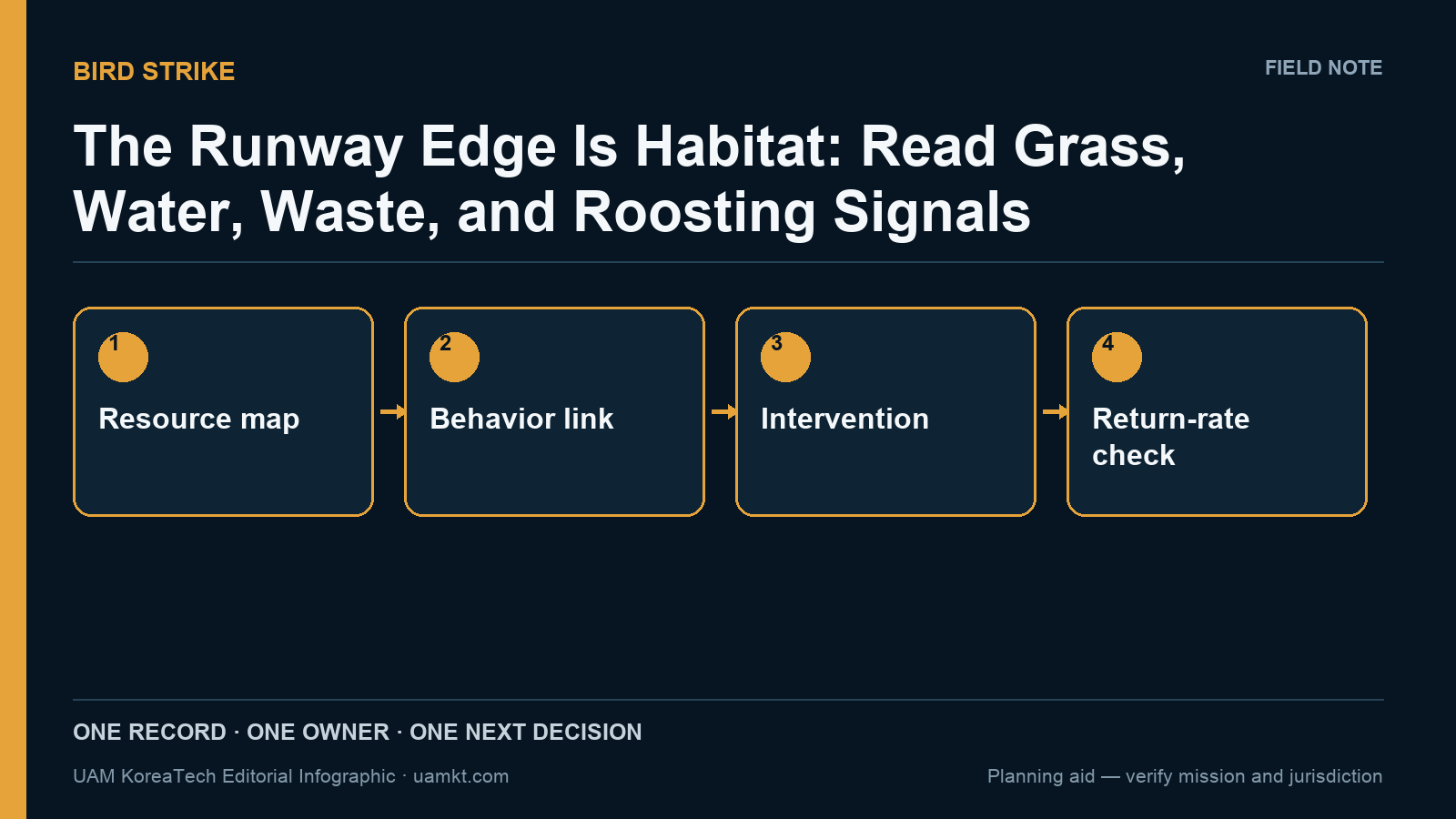
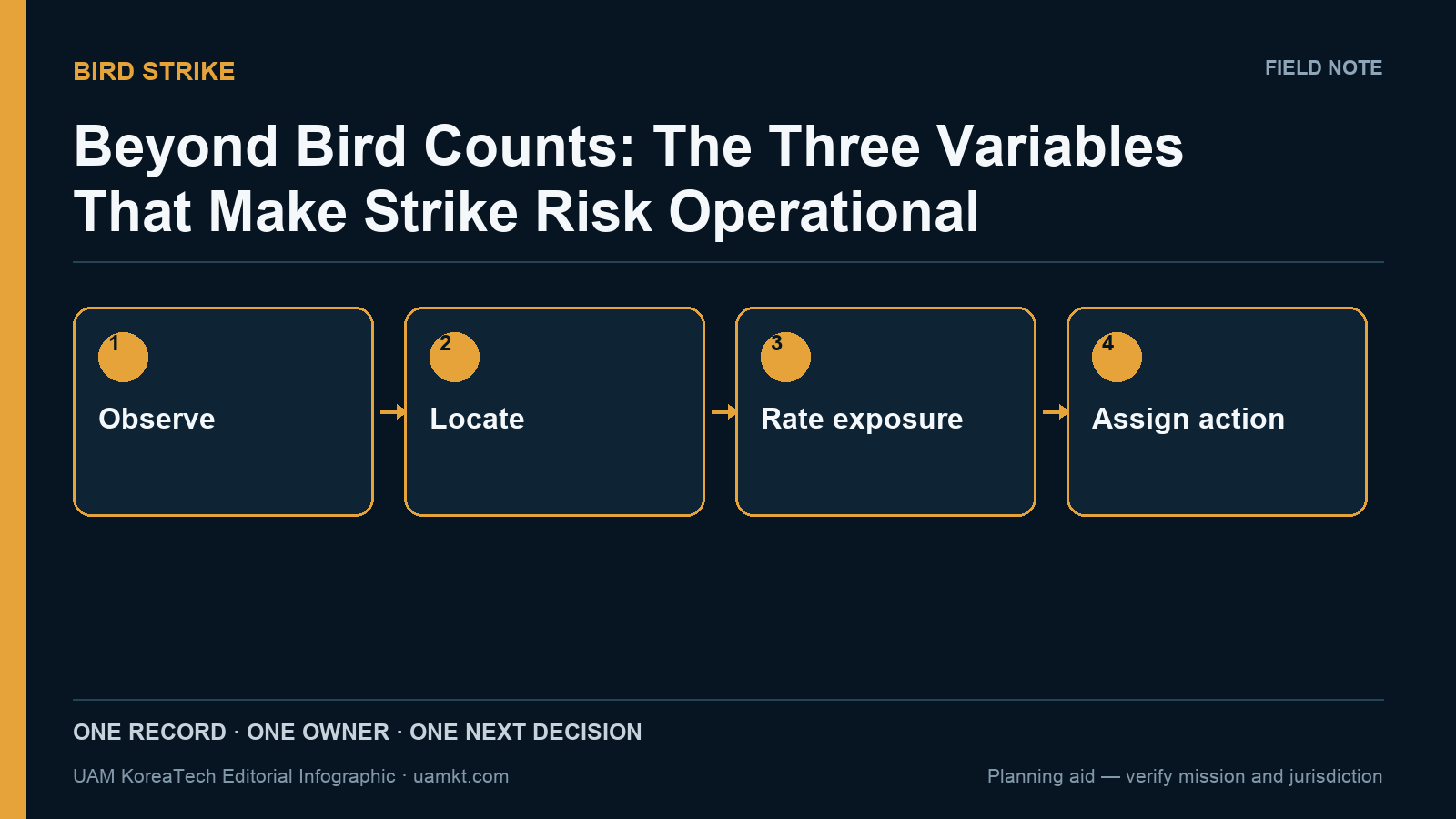
A wildlife-strike report is more than a statistical submission. Properly designed, it is the first controlled record in a local decision chain: observe the event, stabilize immediate safety, preserve facts, submit the appropriate report, review the operational pattern, assign corrective action, and confirm closure. When reporting is treated as an isolated administrative task, the organization loses the connection between the event and the next operational decision.
This article is a management workflow, not a substitute for an airport wildlife-hazard plan, regulator instruction, emergency procedure, or biological assessment. In the United States, consult the FAA’s current Wildlife Hazard Mitigation resources and wildlife-strike reporting resources.
The closed reporting loop
Event observed → immediate safety actions → minimum facts captured → evidence classified → official report submitted → local risk reviewed → action assigned → effectiveness checked → record closed
The official report and the local corrective-action record serve different purposes. The first contributes structured event data. The second documents how the operator interpreted the local significance and what it decided to change.
1. Stabilize operations before collecting detail
The first priority is safe aircraft and airfield operation under the organization’s approved procedures. Reporting must not distract personnel from emergency response, runway inspection, foreign-object removal, or required communication. Once immediate risk is controlled, designate one person to coordinate the event record so that observations are not lost or repeatedly reinterpreted.
2. Capture minimum facts without guessing
Record what is known and separate it from inference. Useful fields include date and local time, airport or location, runway or movement area, phase of flight, aircraft type or identifier as permitted, altitude where relevant, weather and visibility, wildlife number and apparent size, damage or operational effect, parts struck, crew or observer account, and evidence retained.
Do not turn an uncertain species identification into a confident label. Record “unknown bird,” “unknown mammal,” or another appropriate uncertainty when identification is not supported. Photographs, remains, feathers, or other evidence should be handled according to the applicable safety, wildlife, biosecurity, and organizational procedures.
| Evidence status | Example | Reporting treatment |
|---|---|---|
| Directly observed | Time, runway, visible impact location | Record as observation |
| Instrument or record | Aircraft log, maintenance finding, operations log | Link to the source record |
| Supported identification | Qualified identification or accepted lab result | Record source and confidence |
| Uncertain inference | Assumed species or cause | Label as unknown or provisional |
3. Use the current official reporting channel
For United States reporting, use the current FAA process and form. The FAA publishes FAA Form 5200-7, Bird/Other Wildlife Strike Report and related instructions. Confirm the current submission route rather than relying on an old locally saved form.
The report should be timely, complete enough to be useful, and honest about unknowns. A blank field and a guessed field are not equivalent; where the form permits, uncertainty should remain visible.
4. Create a local event record
The official submission may not capture every detail needed for local operations. Create a local record that links the report to runway inspection, aircraft or maintenance findings, wildlife observations, habitat or attractant conditions, operational restrictions, staff actions, photographs, and follow-up tasks.
Assign a stable event identifier and use it across all artifacts. This prevents the report, maintenance record, and corrective-action note from becoming disconnected documents.
5. Review the event in context
A single strike does not automatically establish a trend, and absence of reported strikes does not automatically establish low risk. Review the event alongside traffic, species observations, season, time of day, runway use, habitat conditions, prior events, near misses, and reporting behavior. Normalize comparisons carefully; raw counts can mislead when aircraft movements or reporting rates differ.
The FAA’s Advisory Circular 150/5200-32C provides background on reporting wildlife strikes. Airport-specific obligations and wildlife-hazard management requirements should be confirmed against the current regulatory and operational framework applicable to that facility.
6. Convert review into an owned action
Each corrective action should identify the risk mechanism, action owner, due date, operating constraint if any, evidence of completion, and effectiveness check. Actions may concern inspection, habitat management, waste or water attractants, communication, training, patrol timing, detection, deterrence, reporting quality, or coordination with qualified specialists.
Avoid using technology as the default response before the mechanism is understood. A sensor, drone, radar, camera, or AI classifier may improve observation, but it does not replace operational authority, species expertise, habitat control, or a documented decision rule.
7. Close only after checking effectiveness
Completion is not the same as effectiveness. If the organization changed a patrol, habitat treatment, briefing, or reporting process, define what evidence will show whether the change worked. The check may be qualitative or quantitative, but it must be proportionate, time-bounded, and tied to the original mechanism.
A closure record should state:
- what was observed;
- what immediate controls were applied;
- what report was submitted and when;
- what local analysis was performed;
- what action was assigned;
- what evidence shows completion;
- when effectiveness will be reviewed;
- who authorized closure.
Reporting quality self-test
Select three recent events and ask a reviewer to move from the official report to the local action and effectiveness check using only the event identifier. If any transition requires memory or personal explanation, the reporting loop is incomplete.
Airfield takeaway
High-quality reporting does not merely count strikes. It preserves uncertainty, connects evidence, and creates an accountable next decision. The value of the report is realized only when the organization can show how an observation changed risk control and how that change was later checked.