The launch decision should be one shared picture, not nine separate confirmations in nine separate tools.
Each part of a drone mission can be individually ready while the mission is not. The crew is current, but the site permission expired. The aircraft is released, but the payload configuration differs from the plan. Weather is acceptable now, but the recovery window is not. A readiness brief integrates these dependencies.
The brief should remain short. Identify mission and authority, current weather and forecast decision points, airspace and site status, crew roles and currency, aircraft and software baseline, payload, battery and reserve, data destination, communications, contingencies, and final release authority. Exceptions need a visible disposition.
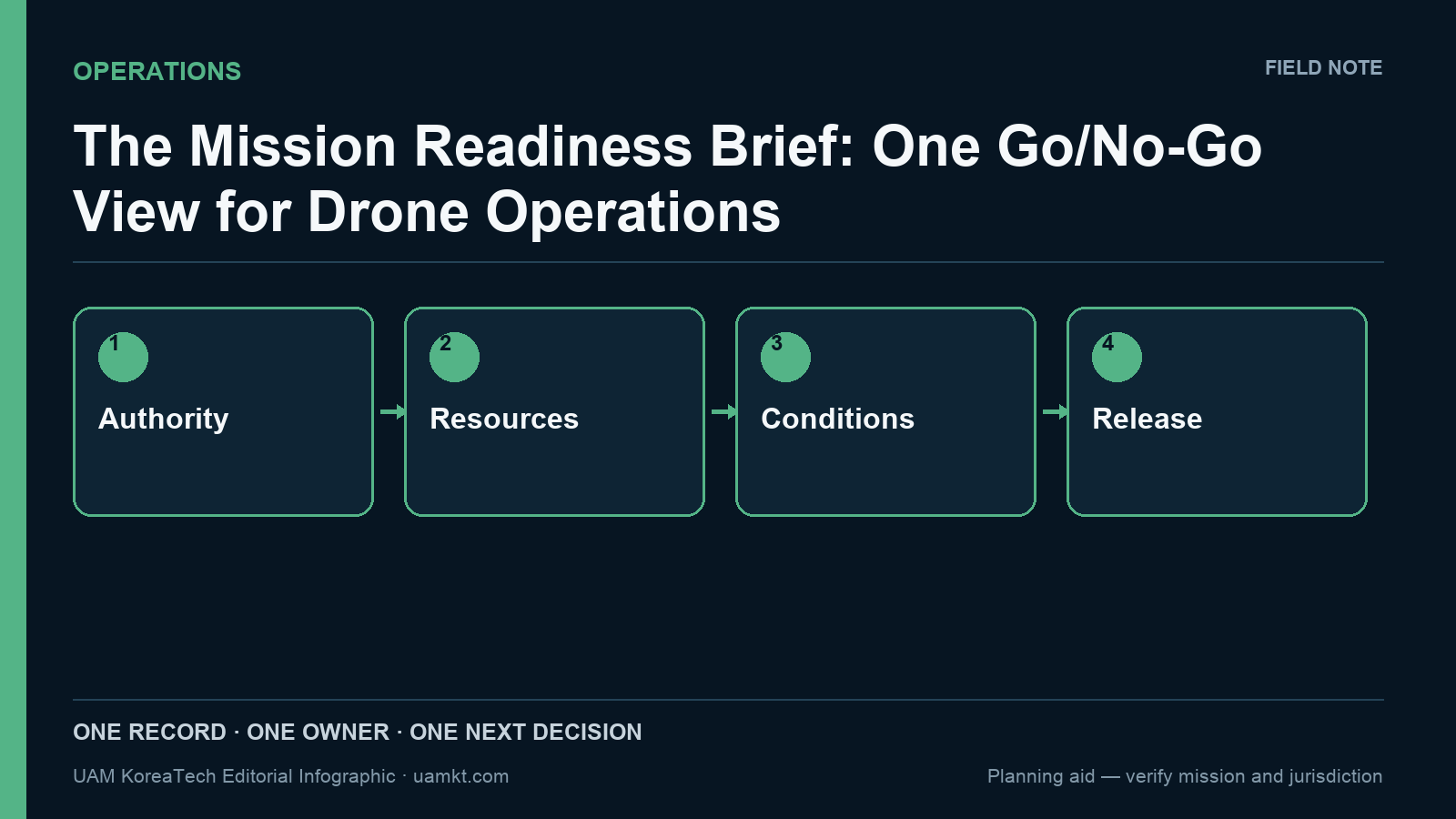
Editorial infographic: Authority → Resources → Conditions → Release. The diagram is a planning aid, not a certification or regulatory determination.
A four-part decision lens
- Confirm mission and authority. Make the condition visible in the same record used for the decision.
- Align environment and time window. Assign an owner and state what evidence will count as completion.
- Verify people, asset, payload, and energy. Keep assumptions separate from observed or approved facts.
- Brief contingencies and abort points. Test the exception path, not only the preferred operating case.
- Record release and later changes. Review whether the control changed the next real decision.
What this looks like in the field
A team completes individual checklists but discovers at the launch site that the client requires a different map output and storage account. The technical flight could proceed; the mission product would fail. A data-delivery line in the readiness brief prevents the false start.
A workflow becomes controllable when the team can explain both progression and refusal. It should be clear why work advanced, why it paused, and what evidence would permit a different outcome. This is especially important when schedules create pressure to convert an unresolved condition into an informal acceptance.
Governance before automation
The brief does not replace detailed procedures. It is the decision index that points to them. Avoid turning it into a long form that crews sign without discussion. Use concise status, named exceptions, and a clear authority statement.
Automate visibility before authority. Reminders, completeness checks, version comparison, and overdue queues can help; release and closure still need an attributable role and an intelligible basis. A fast workflow that hides judgment is harder to govern than a slow transparent one.
The practical test
Review one case that was delayed or overridden. Can the record identify the original trigger, the person with authority, the evidence available at that moment, and the later verification? If not, the organization has stored documents without storing the decision.
Put it to work this week
Find a recurring handoff where two teams interpret readiness differently. Agree on one observable entry condition and one completion artifact, then test them on the next handoff. Keep the disagreement log; it is evidence for improving the rule.
For this topic, use “Confirm mission and authority” as the opening prompt and “Record release and later changes” as the closure check. Keep both the original and revised record so the team can see whether the intervention reduced ambiguity rather than merely changing vocabulary.
A good readiness brief creates one moment when the team can see the whole mission and still choose not to launch.
For the wider workflow, see the related Operations field note and the UAM KoreaTech books and workbooks.
Source and scope note
This column adapts a decision framework from the Drone Fleet Control Room, TCO, and Compliance Evidence Pack workbooks. It is educational and vendor-neutral. It does not replace site-specific safety assessment, procurement law, aviation authorization, technical instructions, or professional advice. Useful primary starting points include: