Korea already treats unmanned aircraft registration as an administrative event. The Aviation Safety Act requires registration of reportable unmanned aircraft, and the official form system includes new registration, change, transfer and retirement. Those obligations matter, but they do not by themselves create a complete drone asset passport. A filing can close the regulatory record while the operating history, component condition, maintenance evidence and next-use decision remain scattered.
That is the business-model gap: the retirement record says that an administrative status changed; it does not automatically preserve the decision evidence needed by a buyer, insurer, lender, public owner or recycler. UAM KoreaTech therefore frames the product as an evidence layer beside the authoritative registry—not as a replacement for it.
The missing handoff
A public or enterprise operator often holds useful information in separate systems: purchase invoices, registration identifiers, airframe and battery serials, maintenance work orders, incident notes, flight logs, insurance records and disposal documents. At retirement, these records rarely travel together. The result is asymmetric information. A potential buyer cannot distinguish a maintained airframe from an unknown-history airframe; a recycler cannot see component provenance; and a finance reviewer cannot reconstruct the exposure without requesting the same documents again.
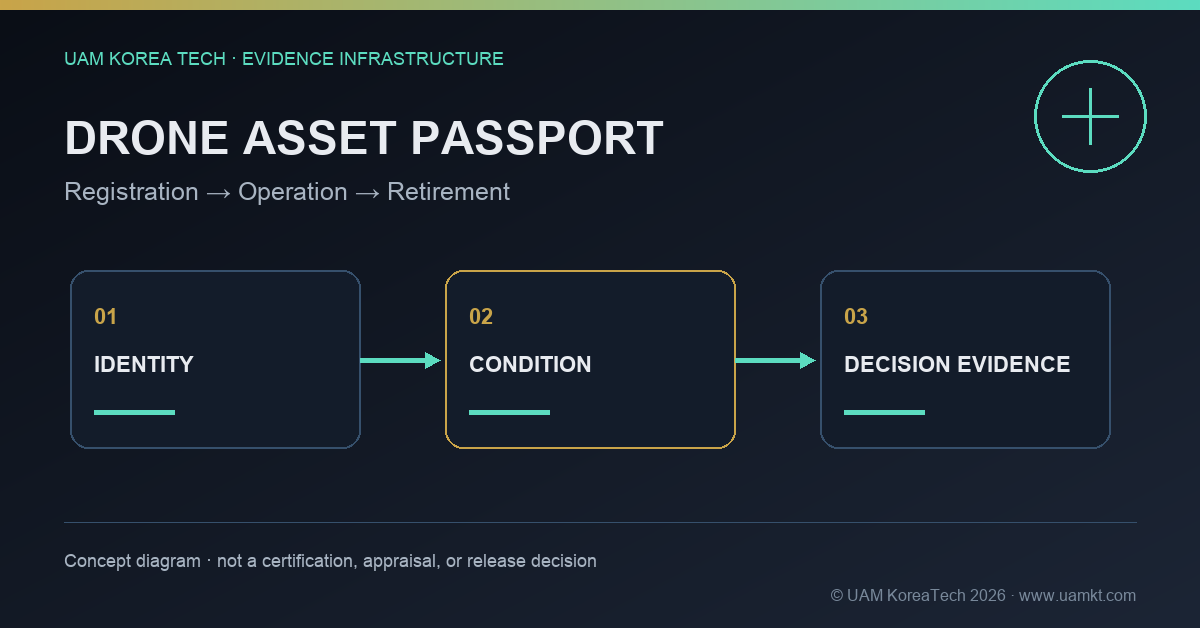
A drone asset passport closes that handoff with three linked records:
- Identity: authoritative identifiers and ownership references, with the source of each field.
- Condition: dated operating, maintenance and component evidence, including what is missing.
- Disposition: the retirement record, handover party, destination and the human decision that authorized sale, storage, recycling or destruction.
The passport should never convert an unknown field into a zero or a pass. Missing evidence remains missing evidence. That discipline is what makes the record usable as decision evidence.
A benchmark, not a borrowed legal claim
The European Union's Ecodesign for Sustainable Products Regulation establishes a Digital Product Passport framework, while the EU Batteries Regulation takes a lifecycle approach to battery information. These are useful data-design benchmarks. This article does not claim that a Korean drone is automatically subject to an EU product-passport obligation. Applicability depends on the product, market and implementing rules.
The useful design lesson is narrower: identity, material or component information, lifecycle events and responsible-party attestations should be machine-readable and traceable to a source. That is the standard a drone asset passport can adopt without overstating its legal status.
From data to a reviewable value range
The platform's valuation function should not announce a single “AI price.” It should produce a range with confidence and reasons. A practical review packet can show acquisition price, verified age, supported flight hours, maintenance completeness, component replacements, damage history, software support status, comparable listings and missing fields. A human appraiser, insurer, lender or procurement officer then decides how much weight to assign.
That boundary matters. The decision evidence can support collateral screening, but it is not an appraisal license, loan approval, title search, safety certification or guarantee of resale. A retirement record can improve provenance, but it cannot prove that a component is fit for reuse.
The first pilot
The minimum credible pilot is not a nationwide registry. It is a controlled cohort of public or enterprise drones in which every asset receives an identifier, a document completeness score and a disposition outcome. Success should be measured by document retrieval time, unresolved ownership fields, missing component histories and whether an independent reviewer can reproduce the reason for the final disposition.
The decisive claim is modest: a drone asset passport preserves the link between identity, condition and disposition so that the retirement record remains connected to the decision evidence. If independent reviewers cannot reproduce that link from the source documents, the pilot fails.
Reader action
If your organization owns, buys, sells, insures, finances or retires drones, send a scoped lifecycle-data request. We will map the evidence fields and gaps before discussing software, valuation or finance.
As of 13 September 2026. This field note is general information, not legal, appraisal, lending, insurance or aviation-safety advice.