The purchase price of a drone is visible. The cost of making it reliably available for an approved mission is distributed across integration, people, infrastructure, software, data, maintenance, downtime, compliance work, and retirement. A total-cost-of-ownership model makes those hidden assumptions comparable before the organization commits to a fleet.
This is a planning framework, not a quotation, accounting standard, or financial recommendation. Cost categories, tax treatment, labor rules, insurance, and regulatory obligations vary by program and jurisdiction.
The lifecycle equation
Use a transparent model rather than one unexplained total:
Program TCO = acquisition + integration + training + infrastructure + authorization/compliance + operations + maintenance + software/data + downtime + retirement − residual value
The model is only as useful as its assumptions. Record the time horizon, fleet size, mission demand, utilization, staffing model, replacement policy, currency, escalation method, and included taxes or fees.
| Cost family | Typical contents | Commonly missed assumption |
|---|---|---|
| Acquisition | Aircraft, payloads, controllers, batteries, chargers, spares | Required redundancy and accessories |
| Integration | Payload, APIs, mapping, networks, workflow, testing | Rework after interface discovery |
| Training | Initial, recurrent, maintainer, evaluator | Staff turnover and proficiency time |
| Infrastructure | Storage, charging, transport, network, test area | Site upgrades and power constraints |
| Compliance | Registration, authorization, documentation, assessments | Internal review and record keeping |
| Operations | Labor, travel, consumables, supervision | Weather cancellations and setup time |
| Maintenance | Scheduled/unscheduled work, parts, batteries, calibration | Shipping and diagnostic delays |
| Software and data | Licenses, cloud, maps, connectivity, retention | Data egress, storage growth, user seats |
| Downtime | Lost missions, substitute service, idle labor | Availability rather than flight hours |
| Retirement | Disposal, data sanitization, contract closeout | Battery and electronic-waste handling |
1. Normalize by the service delivered
Cost per aircraft can mislead when systems deliver different availability or outputs. Choose a service denominator such as accepted inspection kilometer, completed mapping area, available mission hour, delivered payload mission, or verified data product. Define the denominator before comparing bids.
For example:
Cost per accepted mission = total program cost ÷ number of missions that meet the defined acceptance rule
This exposes the effect of failed, cancelled, or unusable missions without pretending that every flight creates the same value.
2. Separate fixed, variable, and step costs
Fixed costs do not change directly with each mission, variable costs do, and step costs increase when capacity crosses a threshold. A second site, additional operator team, larger data plan, or spare aircraft may create a step change. Keeping these categories separate prevents a small pilot from being extrapolated linearly to a fleet.
3. Model availability
Availability links cost to operational readiness. Track scheduled maintenance, unscheduled defects, battery constraints, parts lead time, software holds, weather policy, airspace limitations, staffing, and transport. Avoid one unsupported availability percentage; build scenarios from the actual constraints the organization can measure.
At minimum, compare a base case, a constrained case, and an improved case. State which variables change and why. Sensitivity analysis is more useful than false precision.
4. Include data and software governance
Data can become a larger lifecycle commitment than the airframe. Record image or sensor volume, upload path, retention period, processing, user accounts, backup, cybersecurity controls, export, deletion, and ownership. Identify which fees are tied to aircraft, user, mission, storage, transmission, or analytics.
Also price the process for approving software and parameter updates. An update may be free to download but costly to review, test, document, and deploy across a controlled fleet.
5. Price integration evidence
Include the cost of requirements work, interface testing, simulation, acceptance flights, defect correction, retest, configuration records, and final evidence packs. Omitting these activities makes a lightly integrated product look cheaper than an operational system.
Lifecycle thinking in the NASA Systems Engineering Handbook is useful beyond space programs because it emphasizes early decisions, verification, configuration, and operations across the system life cycle. Apply the principles proportionately to the drone mission and risk.
6. Compare make, buy, and service options on one boundary
Owned aircraft, leased equipment, and drone-as-a-service offers distribute costs differently. Establish one comparison boundary that includes buyer labor, site preparation, data handling, oversight, delay, and exit costs. Do not compare a supplier’s service fee with an owned-aircraft purchase price while excluding the buyer’s operating organization.
7. Define the exit before entry
Record how data will be exported, accounts closed, equipment transferred or disposed, batteries handled, and supplier dependencies replaced. An inexpensive entry with a costly or unclear exit can create avoidable lock-in.
Procurement gate
Require each proposal to populate the same cost workbook and label every value as quoted, calculated, historical, assumed, or excluded. Then run a structured clarification on the five largest cost drivers and the five least certain assumptions. A total without an assumption register should not pass the comparison gate.
Buyer takeaway
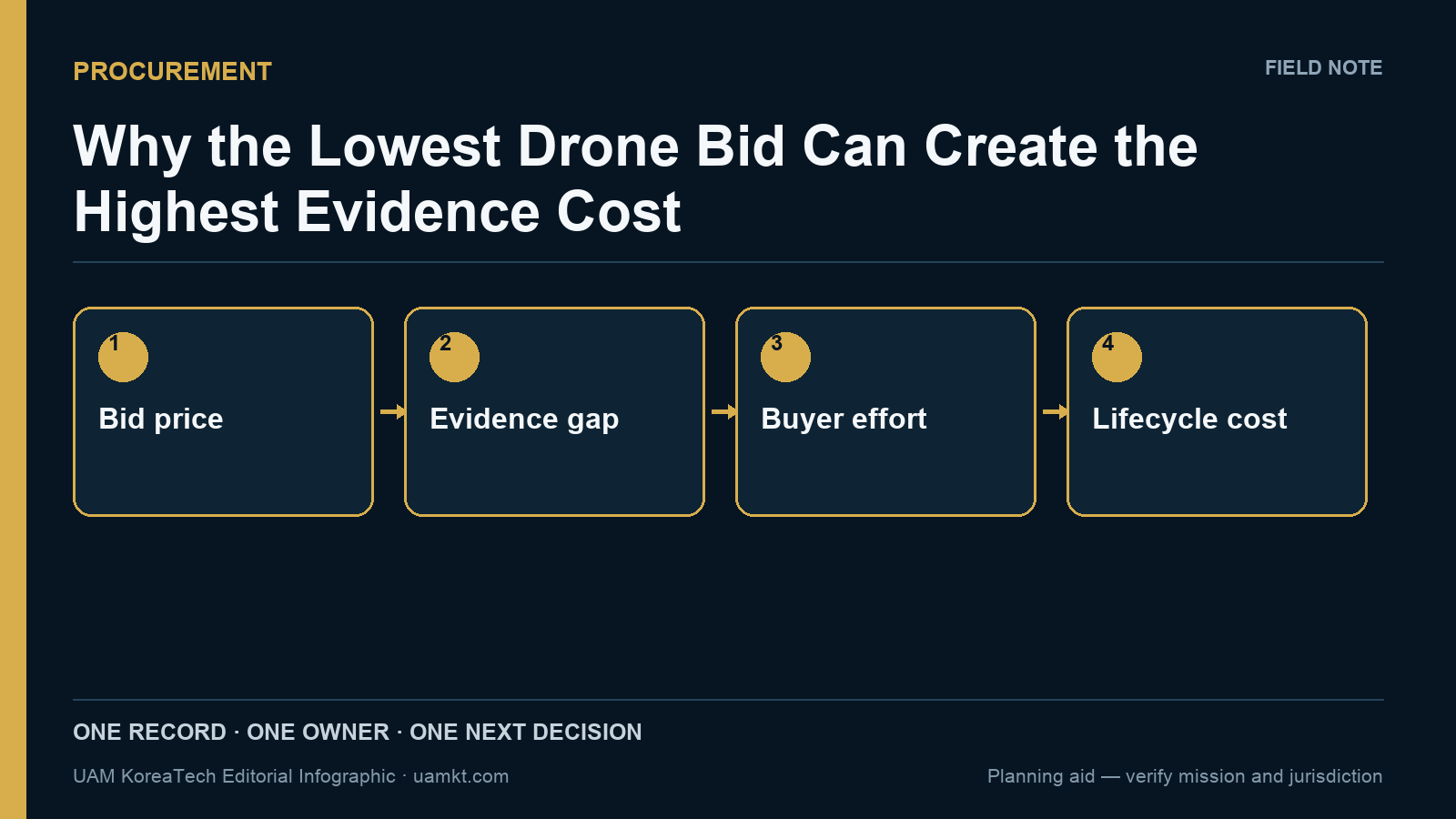
The best-value drone program is not necessarily the lowest-priced aircraft. It is the option that delivers the required accepted service with visible lifecycle assumptions and manageable uncertainty. TCO becomes credible when the buyer can trace each major cost to a mission, configuration, owner, and evidence source.