The number that matters is how many complete mission units can be released at the required time.
Organizations often describe drone capacity by airframe count. That number ignores the conditions that make an aircraft usable: compatible payload, healthy batteries, current crew, approved software, maintenance status, airspace and site permission, weather, and an assigned mission package. Capacity is the intersection of those resources.
Define a mission-ready unit for each service. Then measure availability by time window, not as a permanent label. A mapping aircraft may be ready for one payload and unavailable for another. A pilot may be current on the type but not authorized for the site. A spare airframe without a released battery is inventory, not capacity.
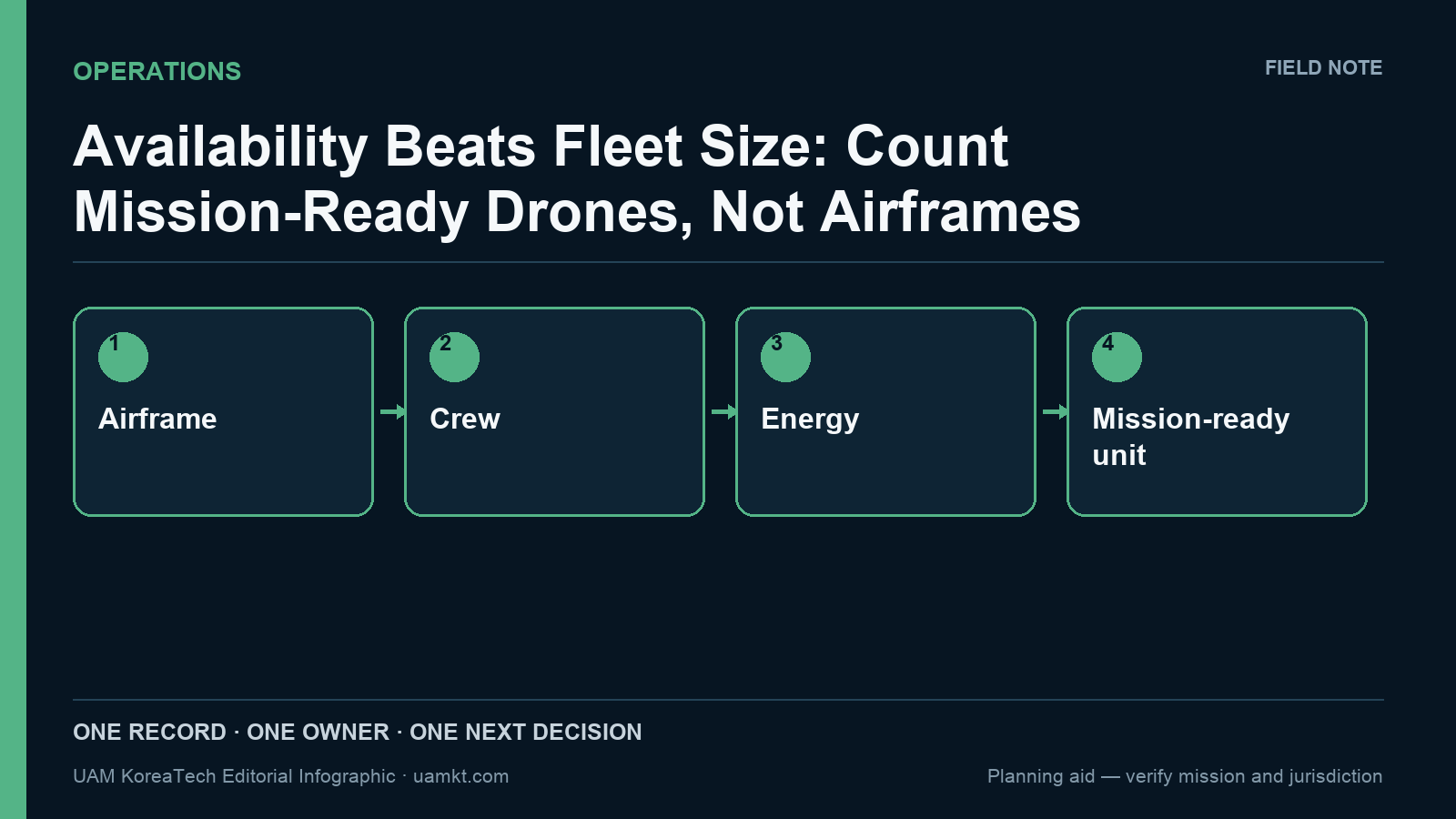
Editorial infographic: Airframe → Crew → Energy → Mission-ready unit. The diagram is a planning aid, not a certification or regulatory determination.
A four-part decision lens
- Define the complete mission unit. Make the condition visible in the same record used for the decision.
- Check asset, crew, payload, and authority. Assign an owner and state what evidence will count as completion.
- Measure by required time window. Keep assumptions separate from observed or approved facts.
- Record the binding constraint. Test the exception path, not only the preferred operating case.
- Use failures to change provisioning. Review whether the control changed the next real decision.
What this looks like in the field
A ten-aircraft fleet promises four simultaneous missions. On Monday morning, two aircraft await parts, three battery sets are below release threshold, one payload is in calibration, and only two crews are current. The realistic capacity is two—not ten and not four.
A useful record shows movement, not just status. “Reviewed” and “acceptable” describe a moment; they do not explain what changed, who accepted the remaining uncertainty, or what condition would trigger another decision. The handoff becomes durable only when evidence, authority, and the reopening rule travel together.
Governance before automation
Availability metrics should not pressure staff to hide defects or bypass controls. Separate controllable readiness loss from weather or external authorization, and show both. The purpose is to improve the system, not punish the person who reports the constraint.
Technology should remove clerical friction after the control has been designed. Start with the decision owner, required fields, exception route, and retained artifact. Only then decide which reminders, calculations, or visual summaries can be automated without obscuring accountability.
The practical test
Hand the record to someone outside the original meeting. If that reader cannot explain the condition, owner, evidence, decision, and next trigger within five minutes, the workflow still depends on oral history. Repair that gap before buying another dashboard.
Put it to work this week
Take one recent case that produced delay or disagreement. Reconstruct the decision from the files that actually existed at the time, mark the first missing fact or authority, and add one control for the next comparable case. Compare reconstruction time before and after the change.
For this topic, use “Define the complete mission unit” as the opening prompt and “Use failures to change provisioning” as the closure check. Keep both the original and revised record so the team can see whether the intervention reduced ambiguity rather than merely changing vocabulary.
Fleet size describes what was purchased. Availability describes what the organization can responsibly promise.
For the wider workflow, see the related Operations field note and the UAM KoreaTech books and workbooks.
Source and scope note
This column adapts a decision framework from the Drone Fleet Control Room, TCO, and Compliance Evidence Pack workbooks. It is educational and vendor-neutral. It does not replace site-specific safety assessment, procurement law, aviation authorization, technical instructions, or professional advice. Useful primary starting points include: