Executives need less raw data and more visibility into unmanaged exposure.
A dashboard can contain hundreds of observations and still leave a leader unable to answer the central question: where are we carrying avoidable risk today? Counts, maps, and trend lines are useful, but only when they reveal action status, evidence confidence, and the recurrence of conditions that the organization already knows about.
The executive view should combine five lenses: current exposure by operating area; high-priority items without an owner; actions past their due date; repeated hazards after intervention; and data-quality gaps that weaken confidence. Each lens should allow a reader to reach the underlying record rather than accepting a summary color on faith.
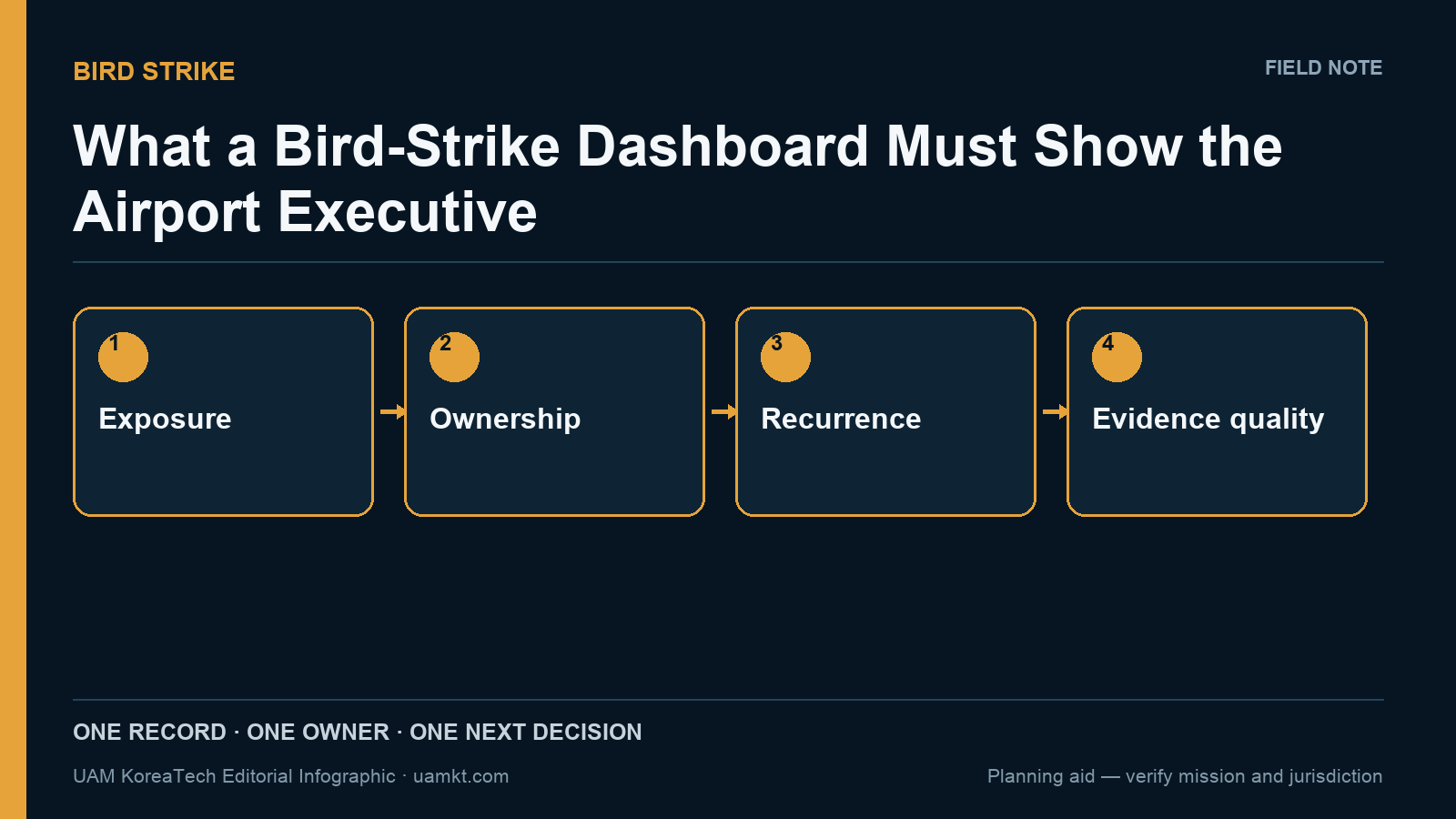
Editorial infographic: Exposure → Ownership → Recurrence → Evidence quality. The diagram is a planning aid, not a certification or regulatory determination.
A four-part decision lens
- Show current exposure. Make the condition visible in the same record used for the decision.
- Flag unowned and overdue actions. Assign an owner and state what evidence will count as completion.
- Compare recurrence after mitigation. Keep assumptions separate from observed or approved facts.
- Display confidence and coverage gaps. Test the exception path, not only the preferred operating case.
- Link every chart to the source record. Review whether the control changed the next real decision.
What this looks like in the field
A monthly slide reports that total observations fell by 18 percent. That sounds positive until the dashboard shows that reports also fell because night coverage stopped, while a threshold location repeated twice after a closure action. The executive question changes from “Are counts down?” to “What risk are we no longer seeing, and what intervention failed?”
The final quality check is reversibility of understanding: another person should be able to walk backward from the outcome to the evidence and forward from the trigger to the required action. When either direction fails, the control is too dependent on memory or personality.
Governance before automation
Avoid ranking staff or contractors by raw report count; that can discourage honest reporting or reward volume over quality. Measure timeliness, completeness, closure evidence, recurrence, and decision traceability. A healthy safety system may initially report more because visibility improves.
Use automation to protect sequence and completeness, not to manufacture certainty. Version the inputs, flag missing fields, show exceptions, and retain who changed what. Keep the basis of the decision visible beside the summary so that speed does not come at the cost of reviewability.
The practical test
Ask two independent readers to classify the same record and name the next required action. If their answers diverge, locate whether the problem is an ambiguous threshold, missing evidence, unclear authority, or an undefined exception path. Fix that variable and repeat the exercise.
Put it to work this week
Pick one decision that will recur this month. Define the smallest complete evidence packet, the responsible role, the response time, and the reopening condition. Observe the next occurrence and revise only from what the trial reveals.
For this topic, use “Show current exposure” as the opening prompt and “Link every chart to the source record” as the closure check. Keep both the original and revised record so the team can see whether the intervention reduced ambiguity rather than merely changing vocabulary.
A useful executive dashboard does not make risk look calm. It makes the organization's response—or lack of response—impossible to overlook.
For the wider workflow, see the related Bird Strike field note and the UAM KoreaTech books and workbooks.
Source and scope note
This column adapts a decision framework from the BirdStrike final manuscript and the AVIX-AI field-note archive. It is educational and vendor-neutral. It does not replace site-specific safety assessment, procurement law, aviation authorization, technical instructions, or professional advice. Useful primary starting points include: