Charge percentage says how full a battery is; it does not say whether that battery is fit for this mission.
Battery selection is often reduced to state of charge. A full battery may still carry reduced capacity, cell imbalance, temperature concern, damage history, or uncertain identity. Dispatch must connect the specific battery to the mission demand and reserve policy, not merely confirm that a charger shows one hundred percent.
The release record should identify battery or set, measured state, health indicators available to the organization, cycle or usage history, temperature, balance or fault status, compatible aircraft, mission energy estimate, reserve rule, and decision. Post-flight data closes the lifecycle by confirming consumption and any anomaly.
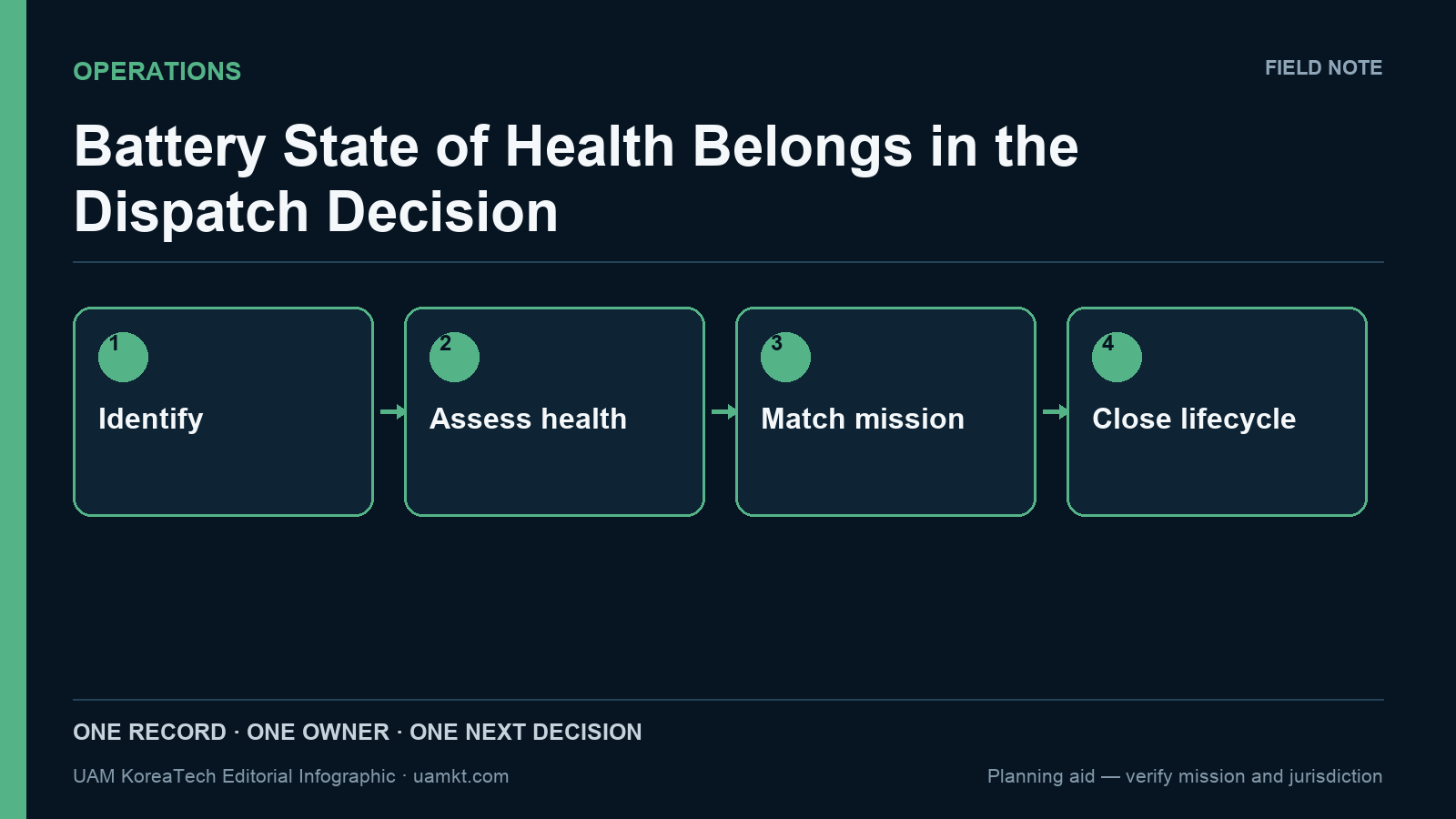
Editorial infographic: Identify → Assess health → Match mission → Close lifecycle. The diagram is a planning aid, not a certification or regulatory determination.
A four-part decision lens
- Identify the exact battery. Make the condition visible in the same record used for the decision.
- Check health and fault history. Assign an owner and state what evidence will count as completion.
- Estimate mission energy and reserve. Keep assumptions separate from observed or approved facts.
- Release or quarantine with reason. Test the exception path, not only the preferred operating case.
- Compare planned and actual consumption. Review whether the control changed the next real decision.
What this looks like in the field
Two identical packs show full charge. One has repeated voltage deviation under load and was previously removed from service pending review. Without identity-linked dispatch, it can return to the flight line as an apparently healthy spare.
Operational confidence comes from a traceable chain, not a confident adjective. The record should connect observation to interpretation, interpretation to authority, authority to action, and action to a verified result. Breaking any link turns review into reconstruction.
Governance before automation
Thresholds must follow manufacturer data, organizational procedure, and applicable technical review. Do not invent universal cycle limits. Quarantine status must be visible across storage, charging, dispatch, and maintenance so a label is not the only control.
A digital form is useful only when its fields correspond to real decisions. Preserve the source observation, distinguish assumption from fact, expose overdue ownership, and keep an audit trail for changes. Do not let a green indicator erase an unresolved exception beneath it.
The practical test
Run a cold-read exercise. Give the evidence package to a colleague with no briefing and ask what happened, what was decided, what remains open, and when the issue returns for review. Record every question that requires a phone call; those questions define the next revision.
Put it to work this week
Use one live or recently completed record as a prototype. Add no new platform. Instead, clarify its source, version, owner, next trigger, and completion evidence. Reuse that structure once before turning it into a standard template.
For this topic, use “Identify the exact battery” as the opening prompt and “Compare planned and actual consumption” as the closure check. Keep both the original and revised record so the team can see whether the intervention reduced ambiguity rather than merely changing vocabulary.
Battery assurance is a chain of identity and evidence. Break the chain and the percentage on the screen becomes false confidence.
For the wider workflow, see the related Operations field note and the UAM KoreaTech books and workbooks.
Source and scope note
This column adapts a decision framework from the Drone Fleet Control Room, TCO, and Compliance Evidence Pack workbooks. It is educational and vendor-neutral. It does not replace site-specific safety assessment, procurement law, aviation authorization, technical instructions, or professional advice. Useful primary starting points include: