If the buyer cannot describe how a requirement will be accepted, the supplier cannot price the same obligation.
Acceptance testing is often treated as a late-stage quality activity. That is too late. By delivery, the parties have already priced, designed, and interpreted the requirement. A newly invented test can look like scope expansion to the supplier and like necessary proof to the buyer. Both may be acting reasonably inside an ambiguous contract.
The solicitation should assign a verification method and retained artifact to every acceptance-critical requirement. The test procedure can mature after award, but its purpose, conditions, measurement source, pass rule, and disposition path should already be visible. This lets suppliers expose exceptions before price and schedule become commitments.
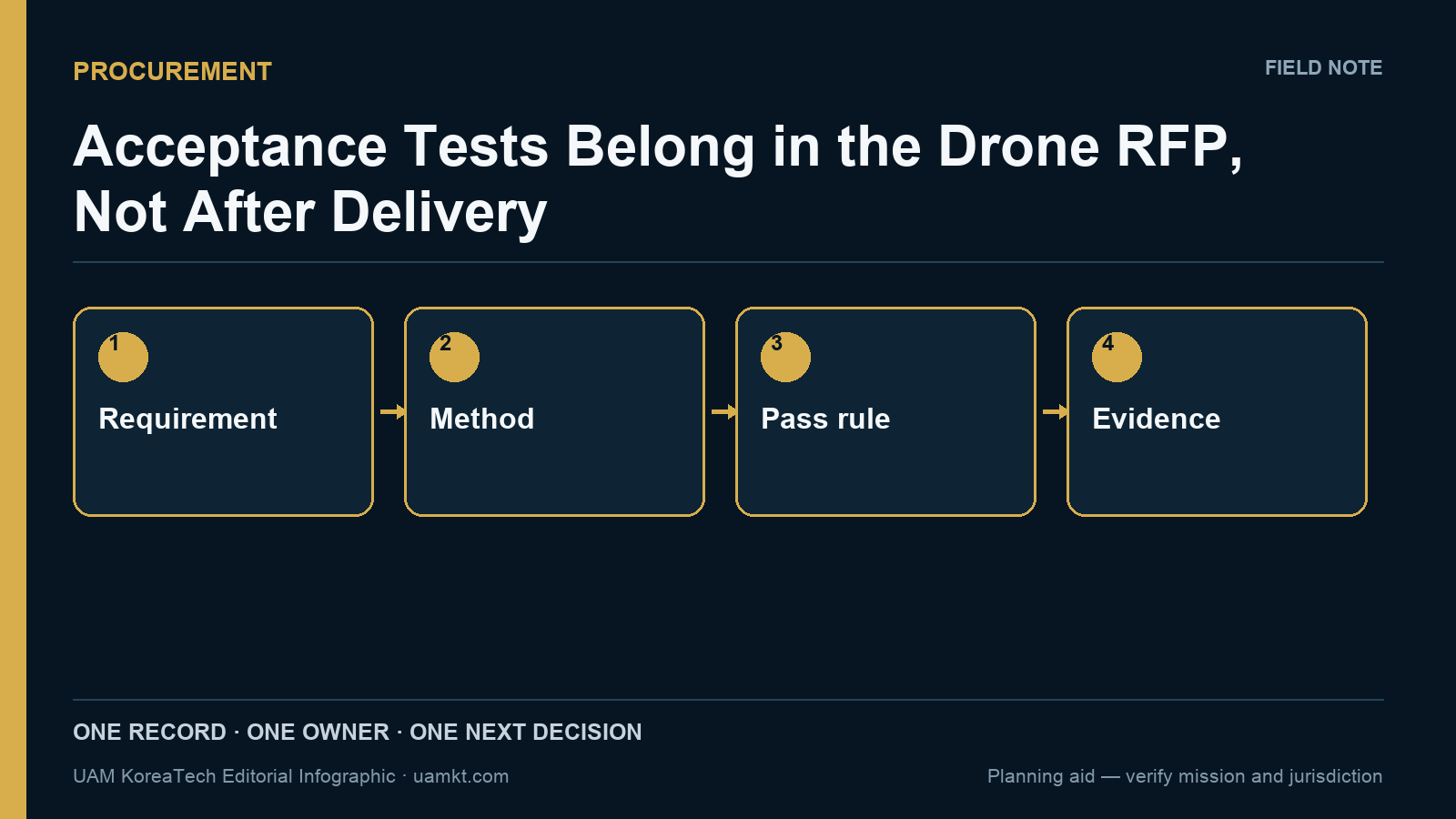
Editorial infographic: Requirement → Method → Pass rule → Evidence. The diagram is a planning aid, not a certification or regulatory determination.
A four-part decision lens
- Mark acceptance-critical requirements. Make the condition visible in the same record used for the decision.
- Assign inspection, analysis, demo, or test. Assign an owner and state what evidence will count as completion.
- Define measurement and evidence. Keep assumptions separate from observed or approved facts.
- State pass, conditional, and fail paths. Test the exception path, not only the preferred operating case.
- Price retest and change control. Review whether the control changed the next real decision.
What this looks like in the field
A buyer asks for “reliable lost-link behavior.” Vendor A assumes a tabletop demonstration; Vendor B prices an instrumented flight test. Their bids are not comparable. A verification note specifying the scenario, configured response, authoritative log, and required witness turns the phrase into a shared obligation.
A useful record shows movement, not just status. “Reviewed” and “acceptable” describe a moment; they do not explain what changed, who accepted the remaining uncertainty, or what condition would trigger another decision. The handoff becomes durable only when evidence, authority, and the reopening rule travel together.
Governance before automation
Not every feature deserves an expensive flight test. Use analysis or inspection where appropriate and reserve operational testing for consequences that justify it. Applicable aviation authorization and safety responsibility remain separate from contractual acceptance.
Technology should remove clerical friction after the control has been designed. Start with the decision owner, required fields, exception route, and retained artifact. Only then decide which reminders, calculations, or visual summaries can be automated without obscuring accountability.
The practical test
Hand the record to someone outside the original meeting. If that reader cannot explain the condition, owner, evidence, decision, and next trigger within five minutes, the workflow still depends on oral history. Repair that gap before buying another dashboard.
Put it to work this week
Take one recent case that produced delay or disagreement. Reconstruct the decision from the files that actually existed at the time, mark the first missing fact or authority, and add one control for the next comparable case. Compare reconstruction time before and after the change.
For this topic, use “Mark acceptance-critical requirements” as the opening prompt and “Price retest and change control” as the closure check. Keep both the original and revised record so the team can see whether the intervention reduced ambiguity rather than merely changing vocabulary.
The RFP is the cheapest place to resolve an acceptance dispute because no one has built the disputed interpretation yet.
For the wider workflow, see the related Procurement field note and the UAM KoreaTech books and workbooks.
Source and scope note
This column adapts a decision framework from the Drone RFP Builder, Supplier Scorecard, and Acceptance Test Manual workbooks. It is educational and vendor-neutral. It does not replace site-specific safety assessment, procurement law, aviation authorization, technical instructions, or professional advice. Useful primary starting points include: