A kilogram collected is not a kilogram safely reused. Voluntary take-back can create the entry point for circularity, but only component evidence can support the next decision. Without a documented reuse gate, a recovery campaign risks becoming a logistics claim with no defensible link to product safety, procurement or environmental benefit.
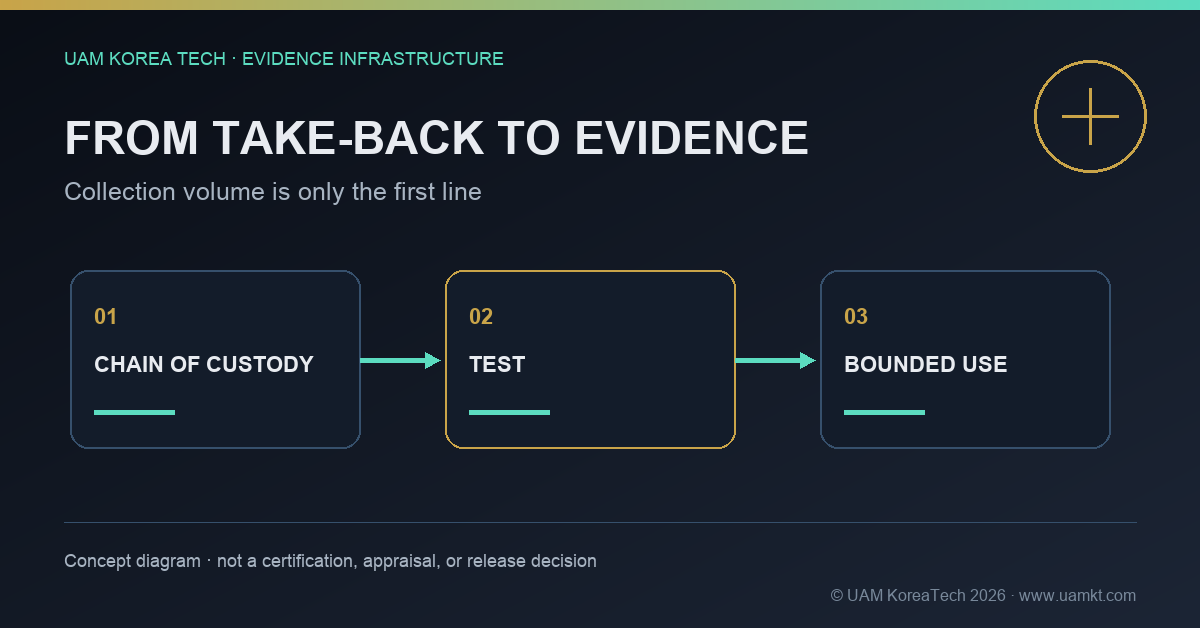
The distinction matters for UAM KoreaTech's proposed recovery model. The idea is not that a spring, battery, airframe or electronics module can move directly from a returned product into a drone. The proposal is to build an auditable sequence in which returned material is accepted, segregated, identified, screened and either released for a strictly bounded secondary use or directed to an authorized recycling route.
What voluntary collection can establish
Voluntary take-back can establish who accepted the item, when custody changed and where it went next. It can also reveal return rates, common failure modes and the information owners are willing to provide. Korea's Ministry of Environment has used voluntary agreements as a policy instrument before expanding producer-responsibility coverage; the toy sector moved from a 2019 voluntary agreement into EPR coverage according to the Ministry's announcement.
That precedent does not make drones or pharmaceutical-device parts subject to the same rule. It shows something narrower: a voluntary program can generate operational evidence before a mandatory regime is settled. A credible pilot must therefore publish its scope, responsible parties and limits instead of presenting collection as regulatory compliance.
The four-part reuse gate
The reuse gate should separate four decisions that are often collapsed:
| Gate | Required component evidence | Decision |
|---|---|---|
| Custody | source, date, handler, sealed identifier | accept or reject the return |
| Classification | part family, known exposure, visible damage, unknowns | segregate or route to recycling |
| Test | documented method, sample basis, threshold and result | candidate or fail |
| Release | named application, responsible approver, traceable lot | bounded use or no release |
The component evidence must be specific to the proposed use. A geometry match does not prove material compatibility, fatigue life, corrosion resistance or cracking pressure. A single bench pass does not prove a production lot. When the source history is unknown, the safest result of the reuse gate may be recycling rather than reuse.
Procurement value comes from exclusions
Buyers need to know what a circular claim excludes. The procurement record should distinguish returned units, screened units, test samples, failed units, released units and recycled units. It should also name the test owner and the receiving system. This prevents collection volume from being reported as reusable output.
For an early pilot, a non-safety-critical, non-flight-critical bench application is the responsible starting point. Real chemical agents, hazardous operational use and uncontrolled installation are outside scope. Any use in spraying, CBRN support equipment or aircraft requires separate material, performance, safety, regulatory and OEM review.
The business model
The platform can charge for evidence services rather than claiming ownership of every recovered item: return intake, serialized chain of custody, screening records, independent test coordination, disposition documentation and buyer matching for authorized material streams. Revenue is tied to a completed evidence packet and verified handoff—not to circularity claims that have not been measured.
The decisive statement is simple: voluntary take-back creates access to returned material; component evidence makes the material reviewable; the reuse gate decides whether any bounded secondary use is defensible. If a reviewer cannot reproduce custody, test and release from the packet, the claimed reuse path fails.
Reader action
Organizations operating return, procurement, test or recycling programs can request a 30-minute evidence-gap scoping call. We will identify one component family and one permitted test path before discussing scale.
As of 13 September 2026. This field note is general information, not environmental, product-safety, aviation, insurance or legal advice.