A drone request for proposal often fails before vendors respond. The failure begins when a mission need is written as a product preference, a performance figure is stated without operating conditions, or an acceptance clause asks for “successful operation” without defining the evidence that will count as success. The result is predictable: suppliers price different interpretations, evaluators compare unlike offers, and the acceptance team inherits arguments that the solicitation should have resolved.
This field guide gives a buyer-side method for preserving one traceable line from operational need to acceptance evidence. It is a planning framework, not legal, certification, or airworthiness advice. Applicable aviation rules, procurement law, airspace authorization, and organizational policy must be confirmed for the jurisdiction and mission.
The controlled chain
Use one chain throughout the solicitation and delivery process:
Mission need → operating scenario → requirement → verification method → acceptance threshold → evidence artifact → disposition
Every important requirement should survive this chain. If an evaluator cannot identify the operating scenario, the verification method, and the evidence artifact, the requirement is not yet ready for release.
| Control field | Question the buyer must answer | Typical output |
|---|---|---|
| Mission need | What decision or service must the system enable? | Mission statement and user outcome |
| Operating scenario | Where, when, and under what constraints will it operate? | Scenario card with environment and interfaces |
| Requirement | What observable capability is necessary? | Numbered “shall” statement |
| Verification | How will compliance be shown? | Inspection, analysis, demonstration, or test |
| Acceptance | What constitutes pass, fail, or conditional acceptance? | Threshold and disposition rule |
| Evidence | What record proves the result? | Log, photograph, report, configuration record, or signed checklist |
1. Begin with the mission, not the airframe
A request such as “supply a long-endurance drone” starts with a preferred solution. A stronger statement begins with the service: inspect a defined corridor, map a stated area, deliver a specified payload, or provide a video stream to an authorized user. Only then should the buyer define the performance and interfaces needed to deliver that service.
Write a short scenario card before writing specifications. At minimum, record the mission owner, operating area, expected users, airspace and site constraints, weather decision rule, payload or data product, command-and-control arrangement, recovery method, and abort condition. If a condition is unknown, label it as an assumption rather than silently transferring the ambiguity to the vendor.
2. Separate five requirement layers
Mixing every concern into one specification makes evaluation and change control difficult. Separate the solicitation into five layers.
Mission performance
Define the accepted output: coverage, payload delivery, inspection resolution, localization accuracy, latency, or mission completion. State the measurement conditions and allowed exclusions.
Operating environment
Describe temperature, wind decision rules, precipitation policy, terrain, electromagnetic environment, lighting, launch and recovery area, and access restrictions. Do not claim environmental capability solely from a marketing brochure; connect each material condition to an evidence method.
System interfaces
Identify payload, power, data, ground-control, mapping, identity, user-account, export, and maintenance-data interfaces. State which interfaces are mandatory at delivery and which may be provided through an agreed integration plan.
Safety and compliance
Identify the applicable operating rule, authorization owner, geofencing or containment approach, lost-link response, emergency roles, record retention, and cybersecurity expectations. For United States civil operations, start with the current text of 14 CFR Part 107 and then confirm whether the mission requires a waiver or another operating framework.
Sustainment and evidence
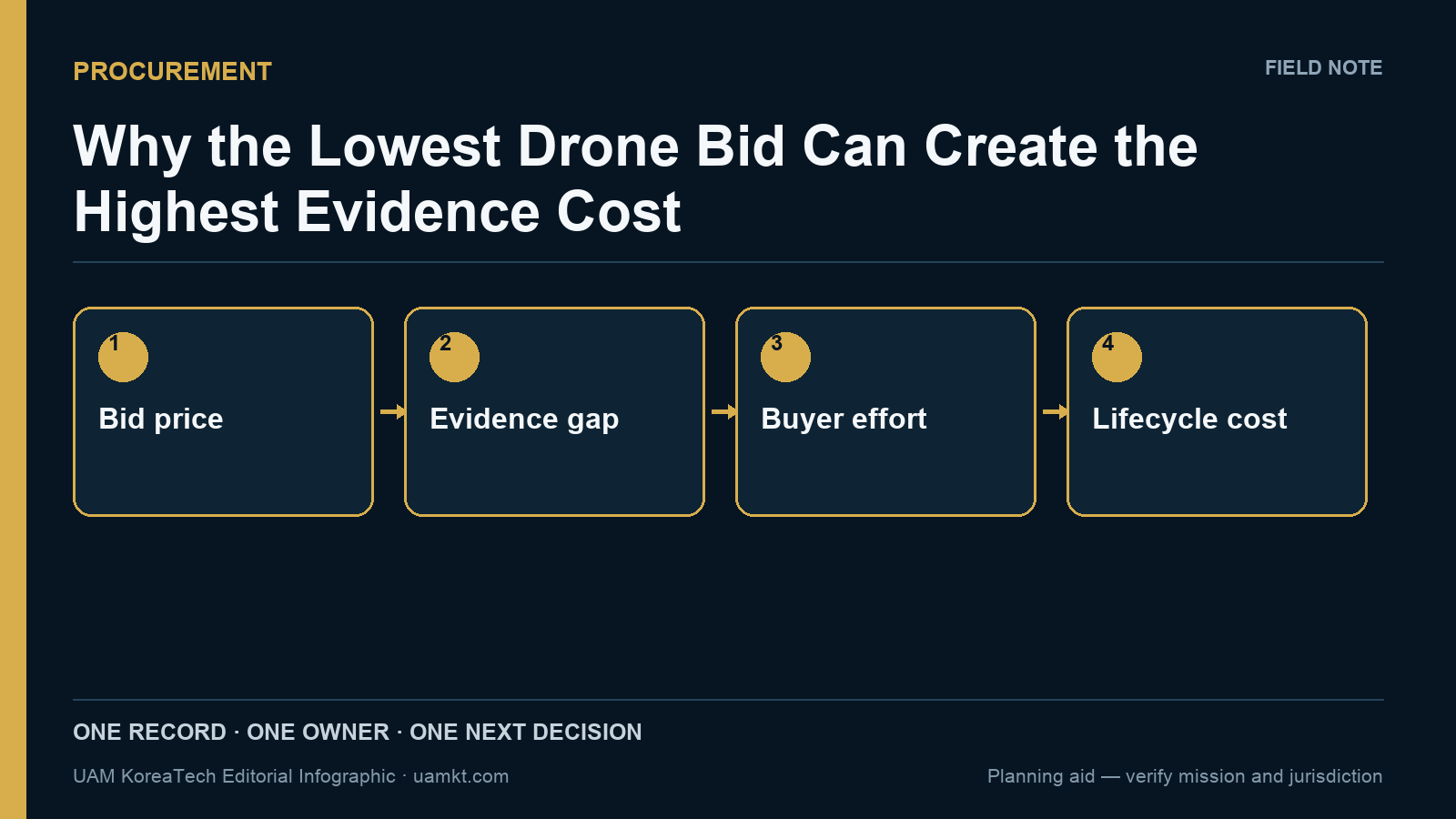
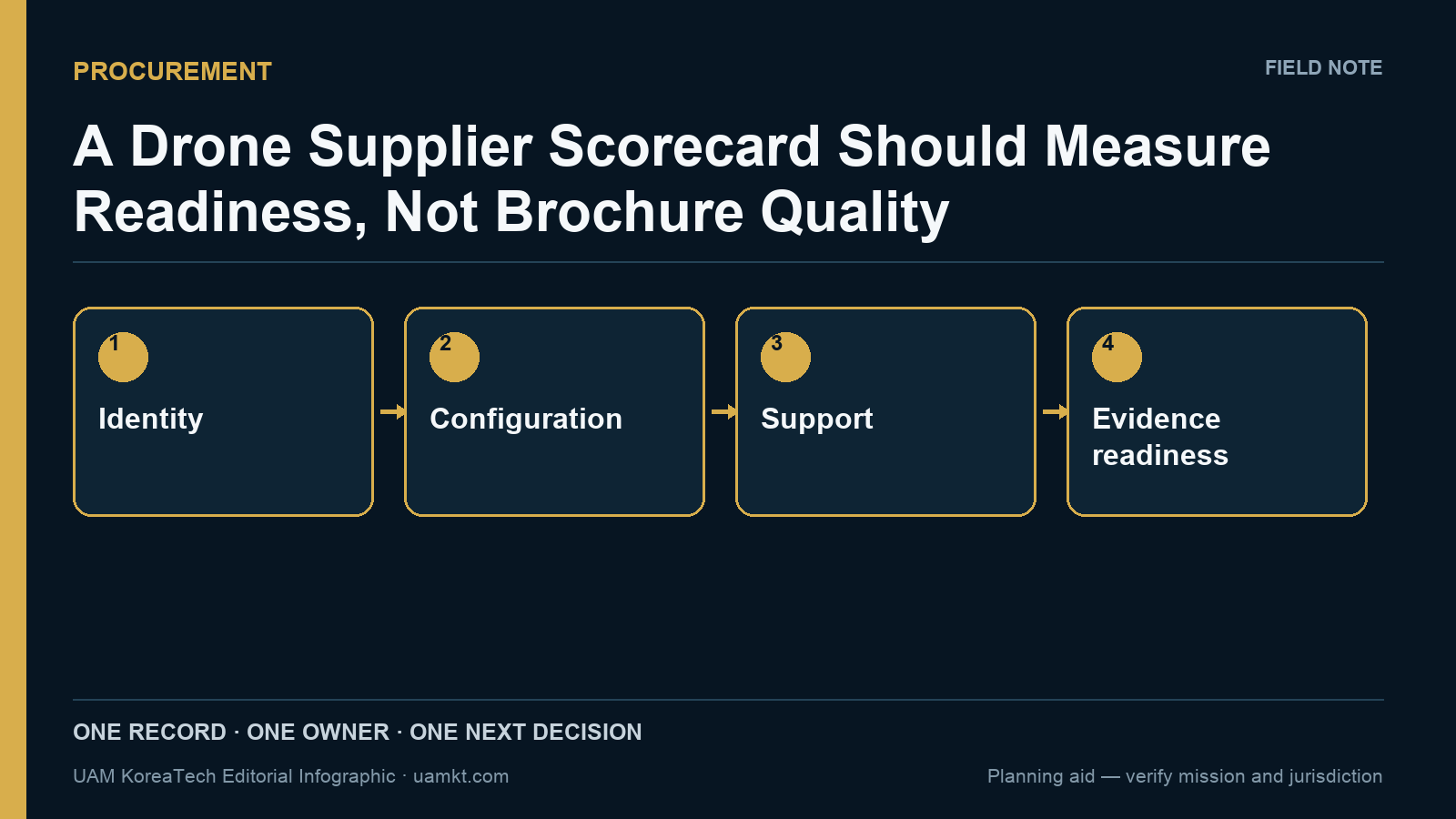
Specify training records, maintenance instructions, spares assumptions, software support, configuration identification, log access, defect reporting, and the final evidence pack. Acquisition price without sustainment evidence is not a complete buying decision.
3. Write observable requirements
An acceptance-ready requirement has a single subject, an observable action or property, defined conditions, and a measurable threshold. Avoid “high performance,” “military grade,” “robust,” “user friendly,” and similar adjectives unless the solicitation defines how they will be judged.
Weak: The aircraft shall provide reliable communications.
Stronger: Under the approved test configuration and test-area conditions recorded in the test plan, the system shall maintain the command-and-control status required to complete the defined route, and shall execute the approved lost-link response when the test director introduces the specified link-loss condition.
The stronger version still needs a route, configuration, measurement source, and pass rule in the test plan. That is intentional: the requirement establishes the obligation, while the controlled test procedure establishes how the parties will observe it.
4. Assign a verification method before release
Four familiar verification methods are useful when applied consistently:
- Inspection: confirm a visible attribute, document, label, interface, or configuration item.
- Analysis: use an accepted calculation, model, or data review when direct test is impractical or incomplete.
- Demonstration: observe a function without instrumented performance measurement.
- Test: measure performance against a defined threshold under controlled conditions.
Do not choose the method after delivery. Assign it in the requirements matrix and identify the required artifact. A test without retained logs, configuration identification, and signed disposition may be persuasive in the moment but weak as acceptance evidence.
5. Make the acceptance clause operational
The contract or purchase document should state who approves the test plan, who may witness, how configuration changes are controlled, what happens when a test is interrupted, how defects are classified, what evidence is delivered, and how retest is authorized. It should also distinguish final acceptance from conditional acceptance and administrative receipt.
A practical acceptance clause should answer these questions:
- Which requirements are acceptance-critical?
- Which configuration is under test?
- Which evidence source is authoritative when observations conflict?
- Who signs the result and by when?
- What is the defect, waiver, deviation, and retest path?
- Which unresolved items prevent payment, release, or operational use?
6. Require an evidence pack, not a performance show
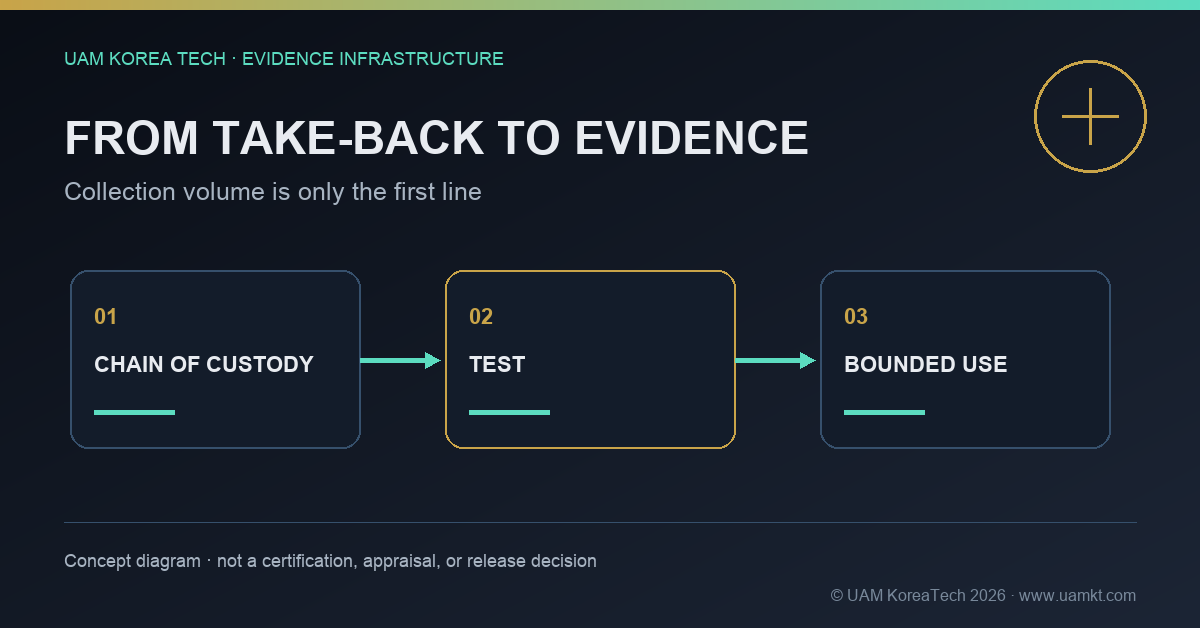
The final deliverable should be a controlled evidence pack. A minimal pack contains the approved requirement baseline, verification matrix, test plan, configuration record, calibration or equipment status where relevant, raw and processed logs, photographs or screen captures where useful, anomaly register, corrective-action record, signed result sheets, and final acceptance decision.
The software architecture may affect what evidence can be recovered. Consult the official PX4 documentation and ArduPilot documentation when defining log access, configuration export, simulation, and ground-control workflows. These sources describe project capabilities; they do not by themselves establish compliance with a particular procurement or certification requirement.
Release gate
Before releasing the RFP, select ten high-consequence requirements at random. For each one, ask an independent reviewer to locate the scenario, verification method, acceptance threshold, and retained artifact. If any link is missing, revise the package before vendors price the ambiguity.
Systems engineering guidance such as the NASA Systems Engineering Handbook reinforces the value of requirements traceability, verification planning, configuration control, and lifecycle thinking. The buyer’s practical task is simpler to state: never ask the acceptance team to invent the meaning of a requirement after the supplier has delivered the product.
Buyer takeaway
A defensible drone acquisition does not begin with the longest specification. It begins with a visible chain from need to evidence. When that chain is maintained, proposals become more comparable, acceptance becomes less subjective, and the delivered system is judged by the mission record the buyer actually needs.