Polished claims are not the same as a supplier’s ability to deliver a controlled system.
Drone proposals are rich in performance language and images. The buyer’s harder task is to determine whether the supplier can reproduce, document, support, and correct what it offers. A readiness scorecard shifts attention from the demonstration moment to the delivery system behind it.
The scorecard should examine corporate and technical identity, comparable delivery evidence, configuration management, airframe and propulsion support, flight-stack ownership, payload interfaces, training capacity, maintenance data, defect response, and financial or schedule assumptions. Unknowns should be scored as unknowns, not silently converted into confidence.
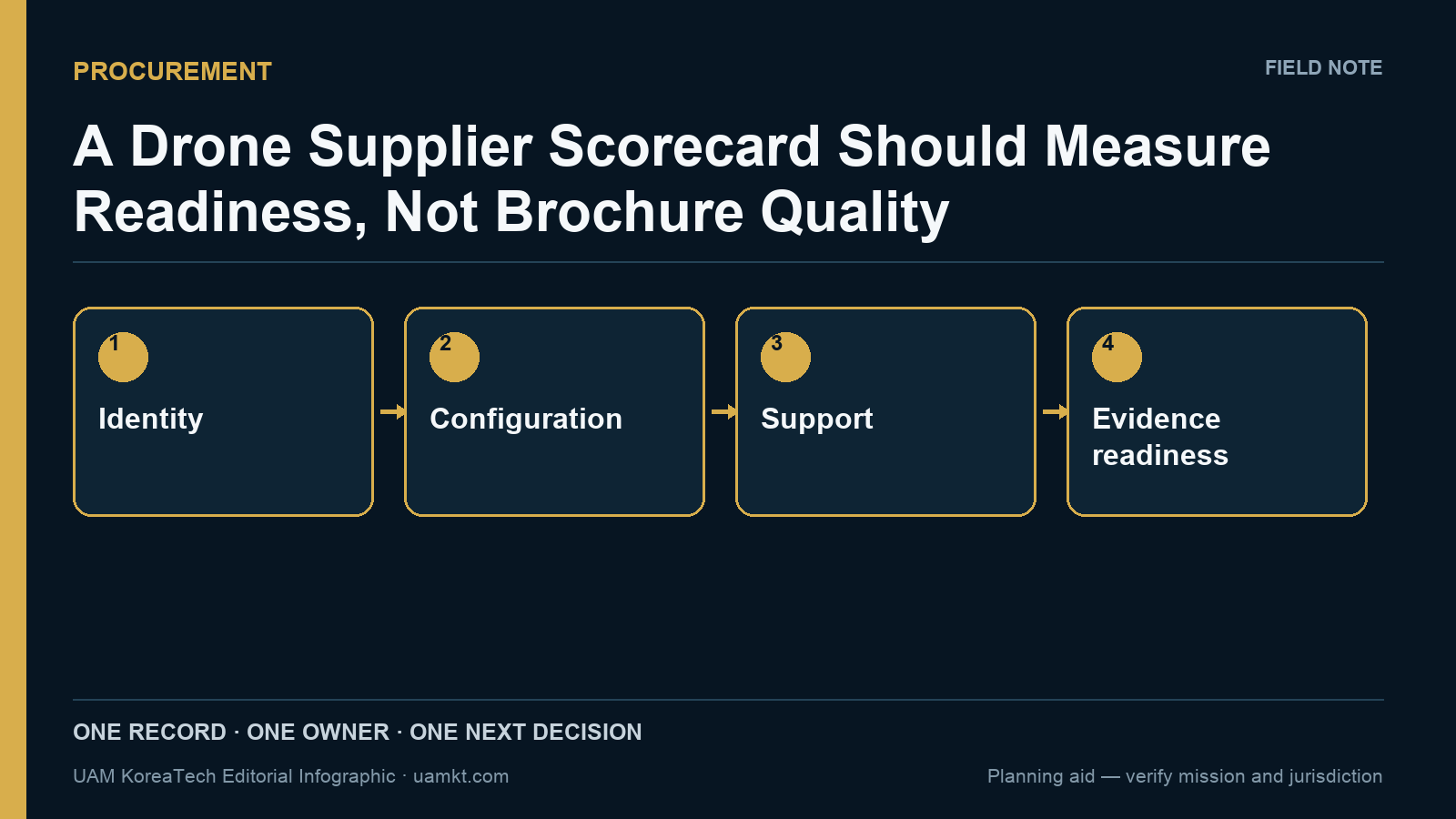
Editorial infographic: Identity → Configuration → Support → Evidence readiness. The diagram is a planning aid, not a certification or regulatory determination.
A four-part decision lens
- Verify identity and delivery authority. Make the condition visible in the same record used for the decision.
- Request representative evidence. Assign an owner and state what evidence will count as completion.
- Trace configuration and interfaces. Keep assumptions separate from observed or approved facts.
- Test support and defect response. Test the exception path, not only the preferred operating case.
- Record assumptions, gaps, and conditions. Review whether the control changed the next real decision.
What this looks like in the field
Two suppliers show similar endurance. One can identify the tested configuration, provide raw logs, name the maintenance interval source, and explain software support. The other points to a video and a future integration promise. A readiness scorecard makes that difference visible without pretending the first supplier is risk-free.
Operational confidence comes from a traceable chain, not a confident adjective. The record should connect observation to interpretation, interpretation to authority, authority to action, and action to a verified result. Breaking any link turns review into reconstruction.
Governance before automation
Weights should reflect mission consequence and be published before scoring. Apply minimum gates to non-compensable concerns: legal eligibility, essential interface, evidence access, or safety-critical response. A high total score should not erase a failed mandatory condition.
A digital form is useful only when its fields correspond to real decisions. Preserve the source observation, distinguish assumption from fact, expose overdue ownership, and keep an audit trail for changes. Do not let a green indicator erase an unresolved exception beneath it.
The practical test
Run a cold-read exercise. Give the evidence package to a colleague with no briefing and ask what happened, what was decided, what remains open, and when the issue returns for review. Record every question that requires a phone call; those questions define the next revision.
Put it to work this week
Use one live or recently completed record as a prototype. Add no new platform. Instead, clarify its source, version, owner, next trigger, and completion evidence. Reuse that structure once before turning it into a standard template.
For this topic, use “Verify identity and delivery authority” as the opening prompt and “Record assumptions, gaps, and conditions” as the closure check. Keep both the original and revised record so the team can see whether the intervention reduced ambiguity rather than merely changing vocabulary.
A good scorecard rewards the supplier that makes verification easier, not merely the supplier that makes the strongest claim.
For the wider workflow, see the related Procurement field note and the UAM KoreaTech books and workbooks.
Source and scope note
This column adapts a decision framework from the Drone RFP Builder, Supplier Scorecard, and Acceptance Test Manual workbooks. It is educational and vendor-neutral. It does not replace site-specific safety assessment, procurement law, aviation authorization, technical instructions, or professional advice. Useful primary starting points include: