A delivered drone system begins changing before the acceptance report is filed.
Drone systems are software-intensive and supply-chain dependent. Firmware changes, component substitutions, payload updates, battery revisions, mobile operating-system changes, and ground-control updates may improve the product. They may also make yesterday’s test evidence incomplete. A contract that treats delivery as a static moment will struggle with the real lifecycle.
The change-control clause should define the configuration baseline, classes of change, notification lead time, impact information, approval authority, regression evidence, documentation update, and emergency-change route. It should also say which changes the supplier may make without prior approval and what records must still be provided.
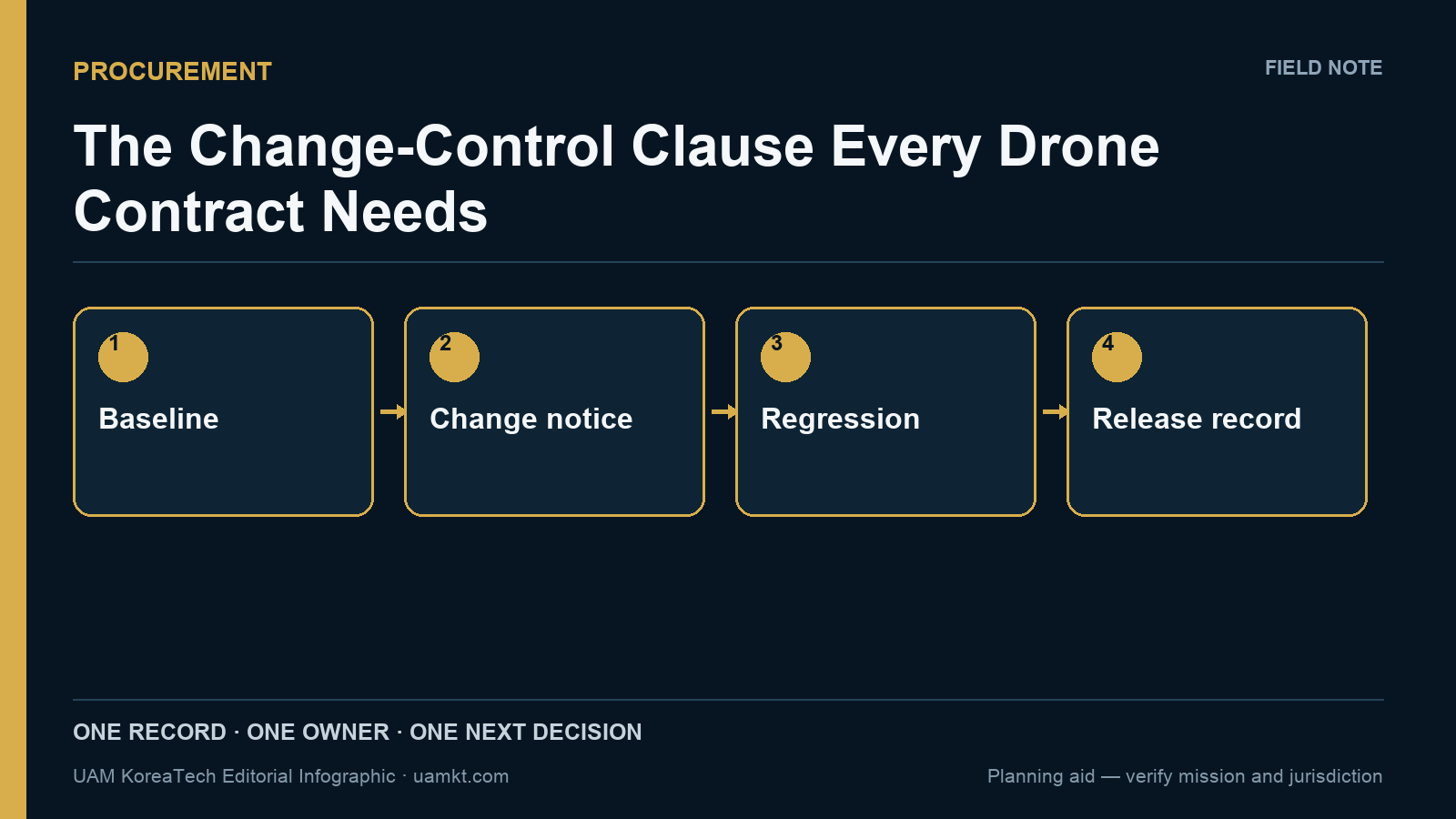
Editorial infographic: Baseline → Change notice → Regression → Release record. The diagram is a planning aid, not a certification or regulatory determination.
A four-part decision lens
- Freeze the accepted baseline. Make the condition visible in the same record used for the decision.
- Classify material and routine change. Assign an owner and state what evidence will count as completion.
- Require impact and regression evidence. Keep assumptions separate from observed or approved facts.
- Update manuals and training. Test the exception path, not only the preferred operating case.
- Record approval, deployment, and rollback. Review whether the control changed the next real decision.
What this looks like in the field
A firmware update modifies return-to-home behavior. The vendor views it as a standard release; the operator views it as a safety-relevant change. A predefined classification and regression matrix prevents the argument from starting after deployment.
The final quality check is reversibility of understanding: another person should be able to walk backward from the outcome to the evidence and forward from the trigger to the required action. When either direction fails, the control is too dependent on memory or personality.
Governance before automation
Change control must not become a blanket ban on maintenance or security updates. The objective is visibility and proportional assurance. Legal counsel and procurement authorities should adapt clause language to the governing contract and operating jurisdiction.
Use automation to protect sequence and completeness, not to manufacture certainty. Version the inputs, flag missing fields, show exceptions, and retain who changed what. Keep the basis of the decision visible beside the summary so that speed does not come at the cost of reviewability.
The practical test
Ask two independent readers to classify the same record and name the next required action. If their answers diverge, locate whether the problem is an ambiguous threshold, missing evidence, unclear authority, or an undefined exception path. Fix that variable and repeat the exercise.
Put it to work this week
Pick one decision that will recur this month. Define the smallest complete evidence packet, the responsible role, the response time, and the reopening condition. Observe the next occurrence and revise only from what the trial reveals.
For this topic, use “Freeze the accepted baseline” as the opening prompt and “Record approval, deployment, and rollback” as the closure check. Keep both the original and revised record so the team can see whether the intervention reduced ambiguity rather than merely changing vocabulary.
A configuration baseline is not bureaucracy around the system. It is the reference that lets the buyer know which system the evidence actually describes.
For the wider workflow, see the related Procurement field note and the UAM KoreaTech books and workbooks.
Source and scope note
This column adapts a decision framework from the Drone RFP Builder, Supplier Scorecard, and Acceptance Test Manual workbooks. It is educational and vendor-neutral. It does not replace site-specific safety assessment, procurement law, aviation authorization, technical instructions, or professional advice. Useful primary starting points include: