“Return home” is a phrase, not a complete recovery design.
When command-and-control is lost, the vehicle must act with limited new information. Return, hold, land, continue, or transition to another link can each be reasonable in one scenario and unsafe in another. The correct response depends on route geometry, terrain, airspace, energy, people, and the status of the recovery site.
Design the response as a state table. Define detection criteria, delay, current mode, altitude policy, navigation source, energy reserve, destination validity, obstacle assumptions, recovery authority, and the condition for regaining control. Then identify combinations that require a different branch.
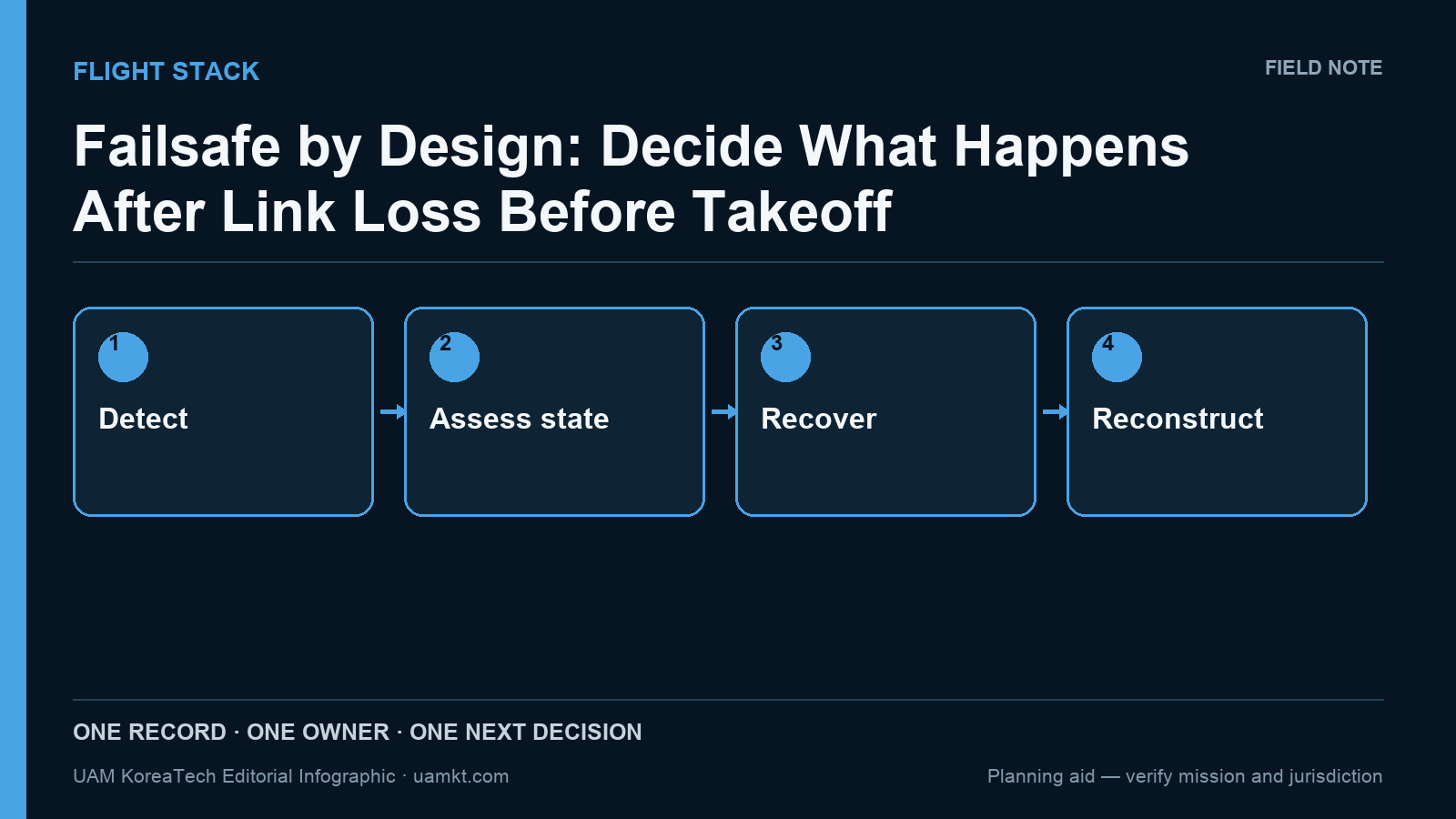
Editorial infographic: Detect → Assess state → Recover → Reconstruct. The diagram is a planning aid, not a certification or regulatory determination.
A four-part decision lens
- Define detection and debounce. Make the condition visible in the same record used for the decision.
- Map mission-specific response states. Assign an owner and state what evidence will count as completion.
- Check terrain, airspace, and energy. Keep assumptions separate from observed or approved facts.
- Test re-link and no-re-link paths. Test the exception path, not only the preferred operating case.
- Retain the authoritative event log. Review whether the control changed the next real decision.
What this looks like in the field
A vehicle operating beyond a ridge loses the primary link. A direct return at a fixed altitude may conflict with terrain; a climb may conflict with airspace; a hold may consume the reserve. The safe logic is not a slogan but a tested choice among constrained alternatives.
Operational confidence comes from a traceable chain, not a confident adjective. The record should connect observation to interpretation, interpretation to authority, authority to action, and action to a verified result. Breaking any link turns review into reconstruction.
Governance before automation
Simulation is necessary but not sufficient. Verify parameters, sensor assumptions, map data, and actual configuration. Conduct only authorized and safely controlled testing. Record overrides and ensure operators understand what the system will do without waiting for a warning to read the manual.
A digital form is useful only when its fields correspond to real decisions. Preserve the source observation, distinguish assumption from fact, expose overdue ownership, and keep an audit trail for changes. Do not let a green indicator erase an unresolved exception beneath it.
The practical test
Run a cold-read exercise. Give the evidence package to a colleague with no briefing and ask what happened, what was decided, what remains open, and when the issue returns for review. Record every question that requires a phone call; those questions define the next revision.
Put it to work this week
Use one live or recently completed record as a prototype. Add no new platform. Instead, clarify its source, version, owner, next trigger, and completion evidence. Reuse that structure once before turning it into a standard template.
For this topic, use “Define detection and debounce” as the opening prompt and “Retain the authoritative event log” as the closure check. Keep both the original and revised record so the team can see whether the intervention reduced ambiguity rather than merely changing vocabulary.
A failsafe is credible when the team can explain its decision path before flight and reconstruct it after the event.
For the wider workflow, see the related Flight Stack field note and the UAM KoreaTech books and workbooks.
Source and scope note
This column adapts a decision framework from the Dronology series and Mission Companion release notes. It is educational and vendor-neutral. It does not replace site-specific safety assessment, procurement law, aviation authorization, technical instructions, or professional advice. Useful primary starting points include: