Why this evidence matters
“Add a larger battery” sounds like a route to longer flight time. In aircraft design, the added energy also brings added mass, which raises lift and power requirements and can demand still more battery. At some point the sizing loop does not settle on a feasible aircraft. This feedback is the battery mass wall.
A TU Delft master’s thesis provides a particularly clear numerical case because it places reciprocating-engine, hydrogen-fuel-cell, and battery systems inside one multidisciplinary design-optimisation framework. The aircraft reference is the General Atomics Predator, a medium-altitude long-endurance aircraft, not a small agricultural multirotor. That distinction makes the study useful for systems thinking but unsuitable as a direct flight-time forecast for commercial drones.
The procurement lesson is that endurance must be quoted with mission altitude, loiter duration, payload, system-level specific energy, and mass convergence. A catalogue value alone cannot show whether a mission closes.
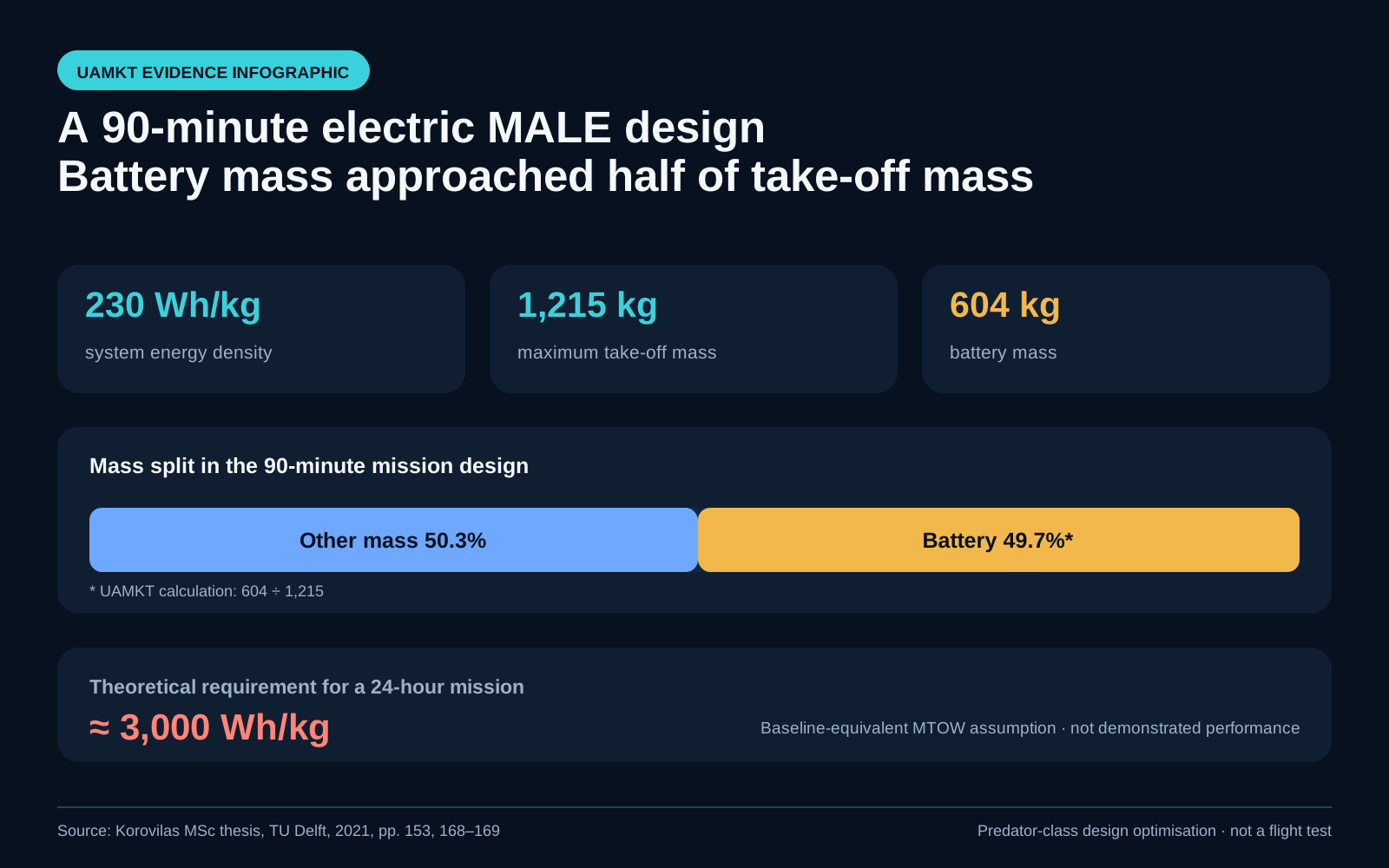
UAMKT editorial infographic based on the cited thesis. The values are design-optimisation outputs for a Predator-class MALE configuration, not flight-test results.
What the thesis tested
Dionisios Korovilas developed a variable-fidelity multidisciplinary design-optimisation framework for a Predator-class MALE UAV. The framework modelled three propulsion architectures: a reciprocating engine, a hydrogen fuel cell, and a battery-electric system. It minimised maximum take-off weight while satisfying a defined mission and aircraft constraints.
The aerodynamic analysis used a low-fidelity relations-based method and a higher-fidelity PANAIR panel-code method. Wing structural weight was estimated either through class-II relations or through a finite-element-based structural sizing method. Comparing these levels allowed the study to show that model fidelity matters when optimisation moves far from the baseline configuration.
The battery model drew on regressions of 1,747 lithium-ion packs and 18650 cells. It applied a Peukert correction with an exponent of 1.02 and distinguished cell-level specific energy from system-level performance. The study used a system-to-cell factor of 0.84 to account for pack housing and management systems. Around 250 Wh/kg represented the upper cell-level range in the underlying model data, while the mission studies discussed below use system-level specific energy.
The additional battery analysis reduced loiter duration from 24 hours to zero. Even with zero loiter, the remaining climb, cruise, and other phases produced a mission of approximately 90 minutes at 20,000 feet. The researchers then increased assumed system-level specific energy until the sizing loop converged.
The numbers to retain
| Quantity | Reported value | What it represents | Source location |
|---|---|---|---|
| Battery regression basis | 1,747 packs and 18650 cells | Input dataset for the battery sizing relationship | Thesis p.101 |
| Peukert exponent | 1.02 | Assumption in the battery-capacity correction | Thesis pp.101–102 |
| System-to-cell factor | 0.84 | Pack-level reduction from cell-level performance | Thesis pp.102–103, 153 |
| Lowest converged system specific energy for the reduced mission | 230 Wh/kg | Model threshold for about 90 minutes at 20,000 ft with zero loiter | Thesis p.153 |
| Maximum take-off weight at that point | 1,215 kg | Optimised Predator-class design output | Thesis p.153 |
| Operating empty weight | 611 kg | Model output at 230 Wh/kg | Thesis p.153 |
| Battery mass | 604 kg | Model output; 49.7% of MTOW | Thesis p.153 |
| Theoretical specific energy for the 24-hour baseline mission | 3,000 Wh/kg | Modelled requirement for similar MTOW, not a tested battery | Thesis pp.168–169 |
| Optimised fuel-cell MTOW reduction versus initial reciprocating baseline | 40.9% low fidelity; 43.6% high fidelity | MDO comparison at the defined mission | Thesis p.169 |
The 604 kg battery fraction can be calculated directly as 604 divided by 1,215, or 49.7%. It is a useful visual expression of the mass loop, but it remains a design-model output. It is not the mass of a built electric Predator.
The 3,000 Wh/kg value is even easier to misuse. It is not a forecast that commercial batteries will achieve that level, and it is not a universal threshold for 24-hour UAV flight. It is the theoretical system-level specific energy required by this model to reproduce a defined Predator-class mission at a comparable maximum take-off weight.
What the study does not prove
The thesis does not report a battery-electric Predator flight test. It does not demonstrate that a 230 Wh/kg pack flew for 90 minutes at 20,000 feet. It identifies where a design optimisation converged under the model assumptions. Real integration would still face thermal management, high-altitude environment, reserve policy, degradation, certification, packaging, redundancy, and propulsion-system validation.
The result cannot be transferred directly to a quadcopter, agricultural sprayer, inspection drone, eVTOL, or small fixed-wing aircraft. Those platforms have different lift physics, mission profiles, hover fractions, propeller efficiencies, payload ratios, climb demands, and reserve rules. A battery system that is inadequate for a 24-hour MALE mission can still be appropriate for a short local mission.
The fuel-cell weight reduction is also not a universal technology ranking. It came from an optimisation framework, reference configuration, mission, component models, and fidelity choices. Hydrogen storage volume, infrastructure, safety cases, cost, reliability, and operational availability require separate assessment.
Design and procurement implications
Every endurance claim should arrive as a mission-energy statement. At minimum it should declare take-off mass, payload, altitude profile, speed schedule, climb and hover time, loiter definition, reserve, battery usable state-of-charge window, expected temperature, wind assumptions, and battery system-level Wh/kg. Cell-level catalogue energy density should not be substituted for installed-system performance.
Design teams should run a coupled mass iteration rather than a one-way spreadsheet. Increasing capacity changes battery mass; changed mass changes required power; power changes usable capacity, cooling, wiring, controller, and structural requirements. A converged result should include margins and a record of the assumptions that produced it. A non-converged result is information, not a software inconvenience to hide.
Procurement comparisons should normalise mission conditions. “120 minutes” at low altitude with no payload cannot be compared with “90 minutes” at 20,000 feet with a defined payload and climb profile. The buyer should request both nominal and degraded cases, including aged packs, cold conditions, headwind, reserve diversion, and one failed module where applicable.
For technology roadmaps, system-level specific energy is the decision variable that matters. Improvements at cell level may be consumed by containment, thermal control, busbars, monitoring, redundancy, and safety separation. The 0.84 factor in this thesis is not a rule for current products; it is a reminder to show the conversion explicitly.
Practical checklist
- State aircraft class and configuration before quoting endurance.
- Separate cell Wh/kg, module Wh/kg, and installed-system Wh/kg.
- Publish battery usable energy, not only nameplate capacity.
- Define climb, cruise, hover, loiter, descent, reserve, and contingency segments.
- Include altitude, temperature, wind, payload, and airspeed assumptions.
- Couple battery mass, required power, structure, cooling, and propulsion in the sizing loop.
- Record whether the design converged and the stopping tolerance used.
- Compare alternatives under the same mission and fidelity level.
- Label simulation, optimisation, bench testing, and flight testing as different evidence levels.
- Do not transfer MALE outputs to agricultural multirotors without a new vehicle-specific model.
- Test sensitivity to battery ageing, low temperature, reserve policy, and payload growth.
- Treat fuel-cell benefits as architecture hypotheses until storage, safety, infrastructure, and field operations are assessed.
Source and scope note
Primary source: Dionisios Korovilas, An Investigation of Electric Propulsion in Unmanned Aerial Vehicles through a Variable-Fidelity Multidisciplinary Design Optimisation Approach, MSc thesis in Aerospace Engineering, Delft University of Technology, 2021. See the TU Delft official record, the institutional thesis PDF, and the exact-title Google Scholar search.
Battery-model inputs are described on pp.101–103. The reduced-mission convergence study is on p.153. The 24-hour and propulsion-architecture conclusions are on pp.168–169. All values in this note are paraphrased from the institutional thesis. UAM KoreaTech has not presented them as flight-test results, current product specifications, or evidence for a small-drone endurance claim.