A stable aircraft can still execute the wrong mission, and a clever mission app can still overload the flight boundary.
Teams often speak of the autopilot as if it were the entire unmanned system. In practice, flight control, navigation, mission sequencing, payload behavior, operator interface, data handling, and enterprise workflow may live in different components. When those boundaries are unclear, testing becomes broad and failure analysis becomes slow.
Start with responsibility. The flight-control layer should own stabilization and approved vehicle behaviors. Mission logic should translate a service objective into bounded commands. Payload logic should manage its own state and evidence. The operator interface should expose authority, status, and exception paths. Each boundary needs a contract and a failure response.
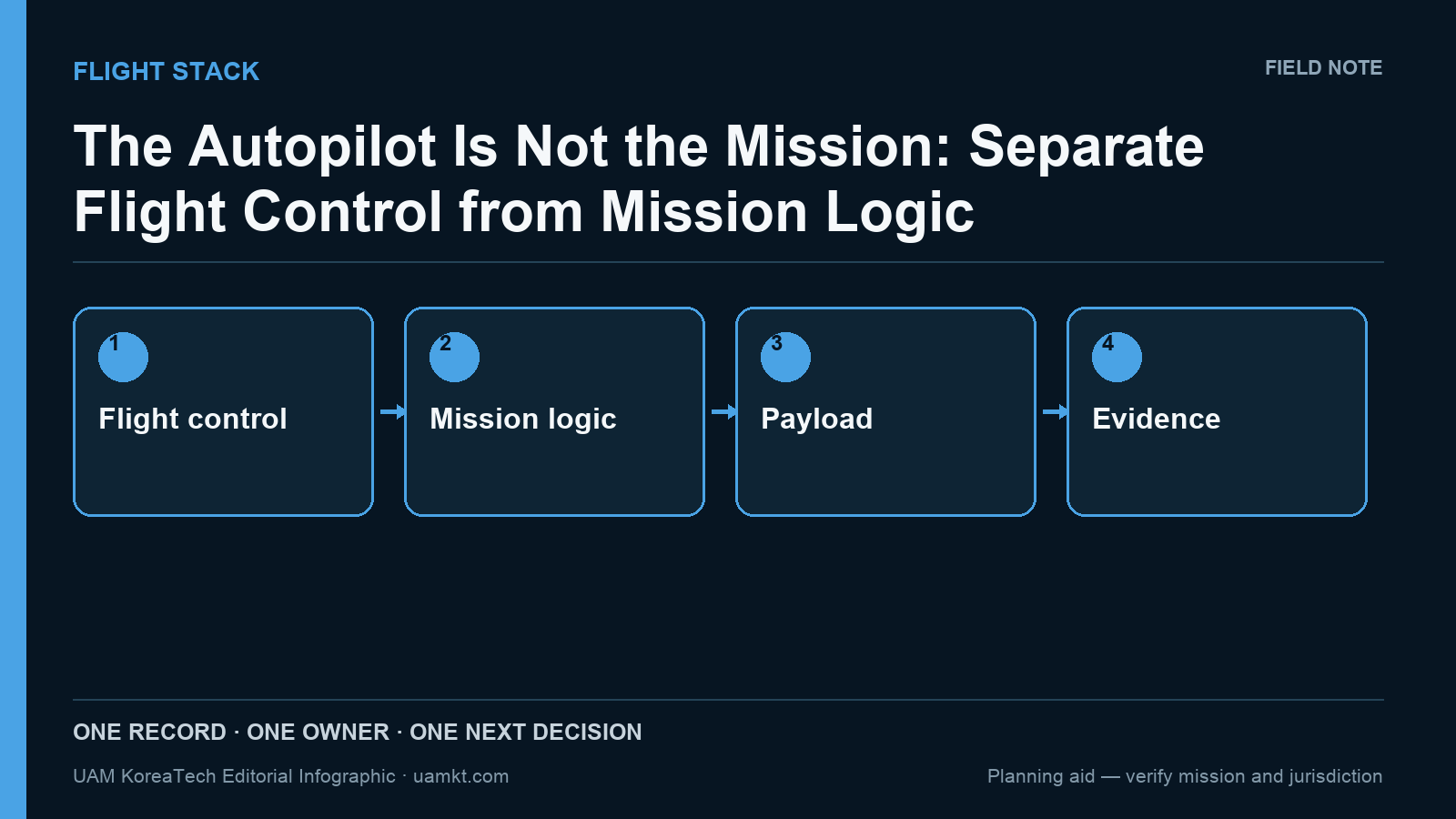
Editorial infographic: Flight control → Mission logic → Payload → Evidence. The diagram is a planning aid, not a certification or regulatory determination.
A four-part decision lens
- Name each layer and authority. Make the condition visible in the same record used for the decision.
- Define messages and state transitions. Assign an owner and state what evidence will count as completion.
- Bound mission commands. Keep assumptions separate from observed or approved facts.
- Design failure containment. Test the exception path, not only the preferred operating case.
- Log decisions across the boundary. Review whether the control changed the next real decision.
What this looks like in the field
A survey application repeats a waypoint after losing an acknowledgement. If the boundary is vague, the aircraft may duplicate a payload action or hold in an unexpected place. A state-machine contract with idempotent commands and a visible timeout makes the behavior testable.
A useful record shows movement, not just status. “Reviewed” and “acceptable” describe a moment; they do not explain what changed, who accepted the remaining uncertainty, or what condition would trigger another decision. The handoff becomes durable only when evidence, authority, and the reopening rule travel together.
Governance before automation
Architecture diagrams are hypotheses until tested. Use simulation, bench integration, and controlled flight to verify normal and off-nominal transitions. Project documentation describes software capability; it does not establish regulatory approval for a specific operation.
Technology should remove clerical friction after the control has been designed. Start with the decision owner, required fields, exception route, and retained artifact. Only then decide which reminders, calculations, or visual summaries can be automated without obscuring accountability.
The practical test
Hand the record to someone outside the original meeting. If that reader cannot explain the condition, owner, evidence, decision, and next trigger within five minutes, the workflow still depends on oral history. Repair that gap before buying another dashboard.
Put it to work this week
Take one recent case that produced delay or disagreement. Reconstruct the decision from the files that actually existed at the time, mark the first missing fact or authority, and add one control for the next comparable case. Compare reconstruction time before and after the change.
For this topic, use “Name each layer and authority” as the opening prompt and “Log decisions across the boundary” as the closure check. Keep both the original and revised record so the team can see whether the intervention reduced ambiguity rather than merely changing vocabulary.
The best stack is not the one with the fewest boxes. It is the one where authority, evidence, and failure stop at understandable boundaries.
For the wider workflow, see the related Flight Stack field note and the UAM KoreaTech books and workbooks.
Source and scope note
This column adapts a decision framework from the Dronology series and Mission Companion release notes. It is educational and vendor-neutral. It does not replace site-specific safety assessment, procurement law, aviation authorization, technical instructions, or professional advice. Useful primary starting points include: