Vertiport-to-Shuttle Last-Mile: Why the App Owns the Handoff
The eVTOL lands and the journey degrades — the last 400 meters from pad to shuttle is where a 25-minute air leg loses its advantage. Why orchestration belongs to the booking app, not the curb.
By Park Moojin · Topic: Vertiport-to-Shuttle Last-Mile: Why the App Owns the HandoffThe pad-to-shuttle handoff fails when ground dispatch reacts to wheels-down instead of final-approach telemetry. Because only the booking app holds a continuous passenger identity across aircraft, gate, and shuttle, journey orchestration — one QR credential, three handoffs, PACE-style fallback — belongs at the app layer, not the curb.
The eVTOL lands. The passenger's journey doesn't end — it degrades.
The brochure version of K-UAM sells a 25-minute hop over Seoul traffic. The operational version includes a stretch the brochure never shows: the last 400 meters from landing pad to ground shuttle, crossed on foot, with a phone in one hand and a bag in the other, while a dispatch system somewhere decides whether a vehicle should begin moving.
That stretch is where the time advantage goes to die.
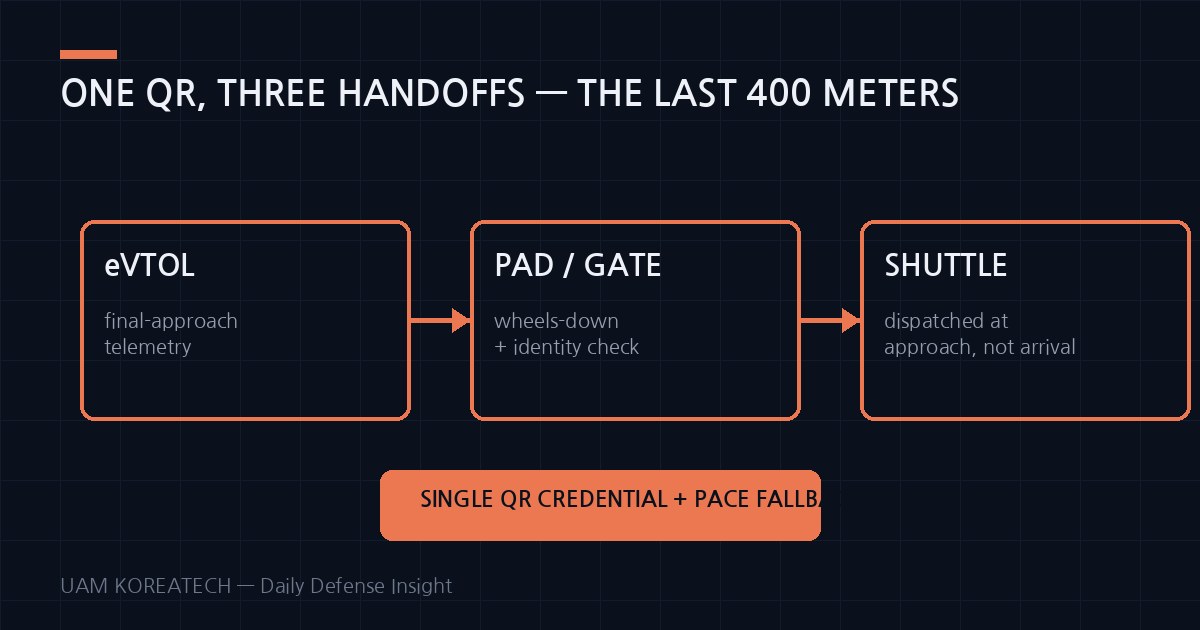
The handoff is a data problem, not a curb problem
Most last-mile planning treats the pad-to-shuttle transfer as a logistics question: how many vehicles, how close to the gate, what turning radius. Those questions matter, but they are second-order. The first-order failure is temporal: ground dispatch that reacts to wheels-down is already late.
An eVTOL on final approach broadcasts its arrival with minutes of warning. A shuttle dispatched at final-approach telemetry meets the passenger at the gate; a shuttle dispatched at wheels-down meets them after a ten-minute curb wait that just consumed the air leg's entire margin (operational estimate — verification required). The fix is not more shuttles. It is moving the dispatch trigger upstream into the flight data.
Only the app sees the whole passenger
Here is the structural reason the booking app must own this orchestration: every other party holds a fragment.
The aircraft operator sees a manifest entry. The vertiport sees a gate event. The shuttle company sees a pickup request. None of them sees a journey — and in the K-UAM consortium structure, the data-sharing agreements that would let any one of them assemble the full picture do not yet exist as standards.
The booking app is the exception. It sold the ticket, so it holds the itinerary; it checked the passenger in, so it holds the identity; it processes the payment, so it holds the incentive. Orchestration follows identity. The app layer is not the convenient place for the handoff — it is the only place with the data to do it.
One QR, three handoffs
The implementation pattern we model is a single credential carried across three transitions: boarding at origin, gate exit at the vertiport, shuttle pickup at the curb. One QR, presented three times, with each scan updating the downstream leg's timing.
The failure mode is obvious — networks drop, screens crack — which is why the credential needs a PACE-style fallback ladder (primary, alternate, contingency, emergency): QR first, NFC tag second, name-plus- manifest third, human override last. A handoff architecture without a fallback ladder is a fair-weather system, and Korean operations do not get to choose the weather.
The 2027 test
The operators who win K-UAM's commercial window will not be the ones with the best aircraft. Airframes converge; certified performance envelopes will look remarkably similar across the field. What will not converge — what is being designed right now, mostly by omission — is whether three vehicles feel like one trip.
That is decided in the last 400 meters, by whoever owns the handoff.
Field analysis by UAM KoreaTech. Service-design timings are operational estimates pending operator validation; corridor and consortium references follow the MOLIT K-UAM Roadmap 2030.
Frequently Asked Questions
Why does the last 400 meters erase the eVTOL time advantage?
A 25-minute air leg saves roughly 40-50 minutes against Seoul surface traffic on comparable corridors, but an unmanaged pad-to-shuttle transfer — identity re-verification, curb queuing, dispatch that starts only after landing — routinely consumes 10-15 minutes (operational estimate, verification required). The air leg's advantage is not lost in the air; it is lost standing at the curb.
Why should the booking app, rather than the vertiport operator, own the handoff?
Each operator in the chain sees only a fragment: the aircraft sees the flight leg, the vertiport sees the gate event, the shuttle sees a pickup request. The booking app is the only party holding a continuous passenger identity and itinerary across all three. Orchestration placed anywhere else requires data-sharing agreements that K-UAM consortium structures have not yet standardized; placed at the app layer, it requires only telemetry subscription and a shared credential.